Deadly Typos

A typo, or typographical error, is a fairly commonplace thing and an inherent danger of the printed word. Historically such errors have at times produced catastrophic and very costly results. The lack of a hyphen in some computer coding cost NASA hundreds of millions of dollars in an aborted rocket launch and there are many more such examples. But by far the worst and most deadly typo in history is that of the Mardin fatwa written originally by Ibn Taymiyya (d 1328) who was from the Mardin area of Turkey at the time of the Mongol invasion. http://en.wikipedia.org/wiki/Ibn_Taymiyyah

To scholars and students of this subject, this fatwa problem is well known, but for many who are not familiar with the subject, it is worth revisiting here as the fatwa is suddenly of immense topicality. The text was, and is still used by many militant terroristic groups to support and justify their killings of countless numbers of innocent people. From those who assassinated Anwar Sadat on the 6 October 1981, to Al-Qaida and more recently the hordes of ISIL, this was their pretext. And they all got it wrong because of a misprinting. If this isn’t a cause for the most bitter remorse and regret, I don’t know what is. More information on this here: http://muslimmatters.org/2010/06/29/the-mardin-conference-–-a-detailed-account/
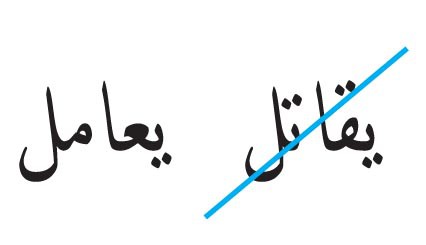
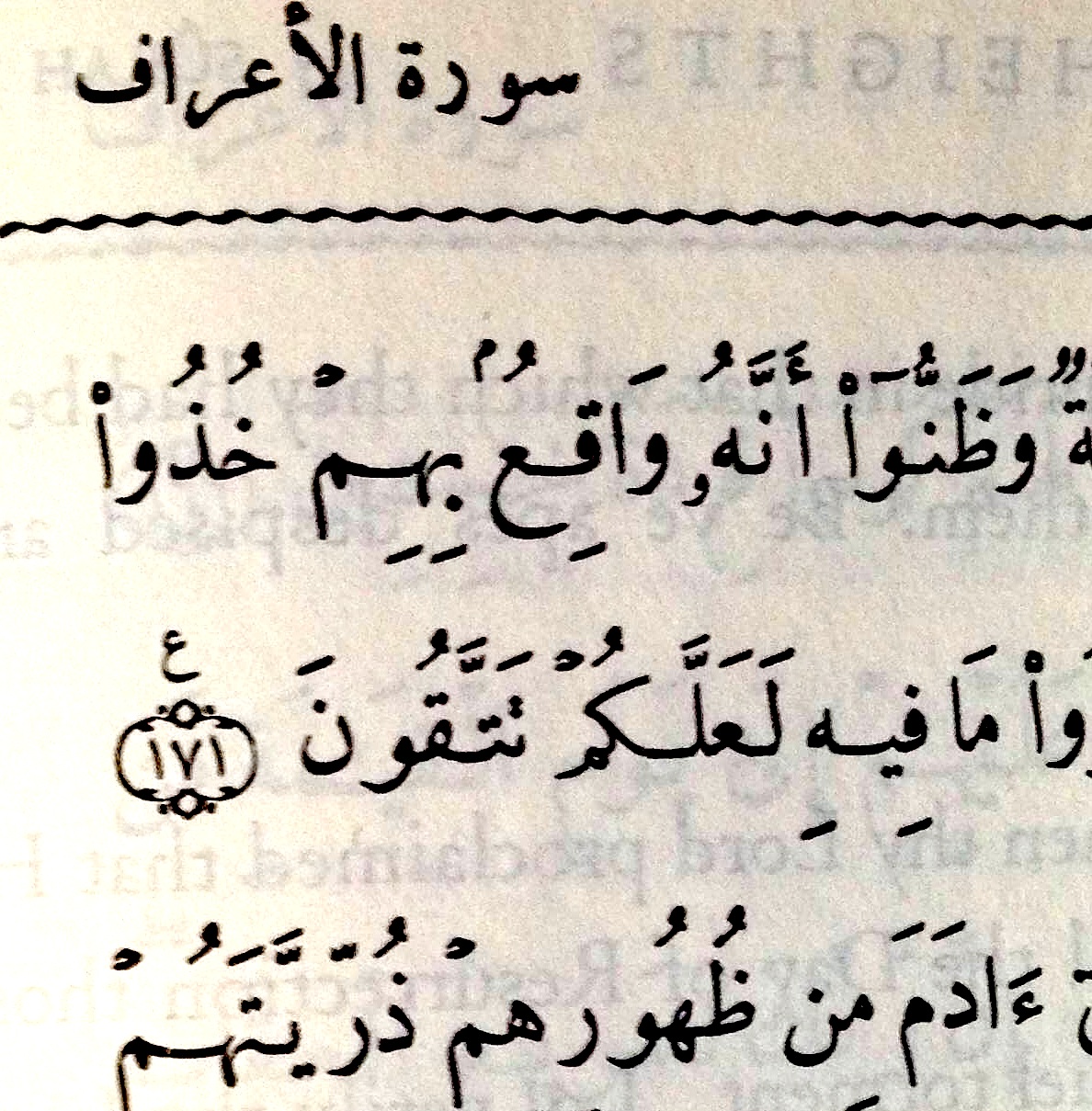
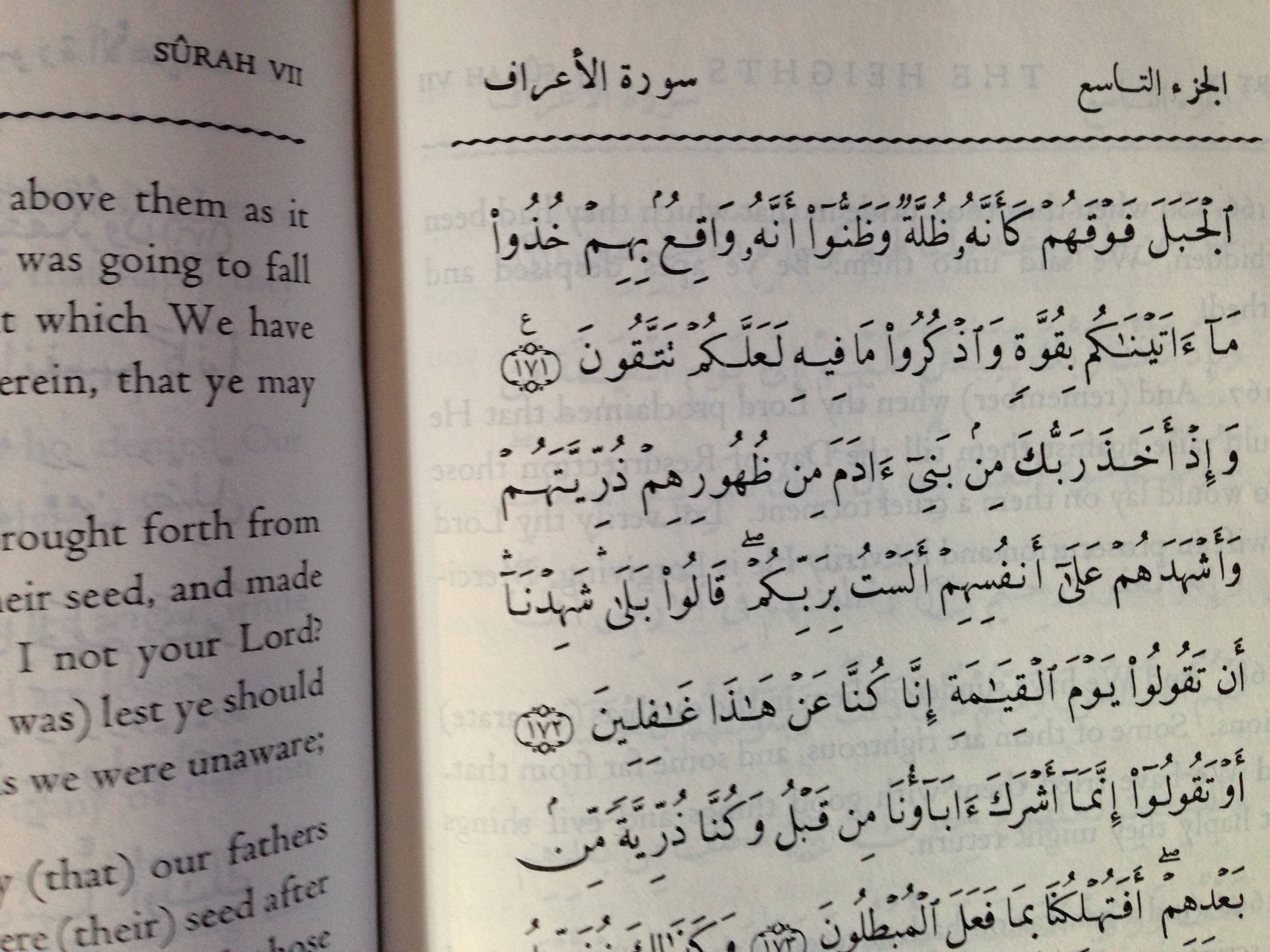
mardin fatwa arabic

Left: The contentious words in arabic. The ‘ayn’ could have been mistaken for a ‘qaf’ but the other letter is clearly a ‘mim’. 

The relevant part of the fatwa text (in Arabic) was  yu’āmal (trans. should be treated), but the word was rendered yuqātal (trans. should be fought) in subsequent printings. This typographic error changes the meaning of the phrase drastically. Was it malicious? We shall never know. I believe Ibn Taymiyya would have been astonished to see how this typo changed its meaning and how it became a mandate for some to kill anybody who they considered an unbeliever (takfir). The ISIL insurgency currently threatening the whole of Iraq and Syria is turning into a mindless Mongol-like invasion of its own, very much like the original invasion of Ibn Taymiyya’s homeland that drove him to flee.

The detective who unearthed the Mardin Fatwa error was Sh. Abdallah bin Bayyah, the  distinguished Mauritanian scholar, who tracked down the oldest written version of the fatwa from the Asad library in Damascus, and it is no coincidence that he is the one scholar who is currently presenting wise counsel in this very difficult time. He addressed the UN last week on the subject of terrorism and was also quoted by Barack Obama in his own address to the assembly. It also made it to many front pages of newspapers around the world. He stated rightly that bombs do not change ideas and that the only realistic course is teaching the next generations that the pursuit of terroristic violence is not a path to paradise and is contrary to all Qur’anic and Prophetic teaching. And that it will take time. Because of his stature and the respect Shaykh Abdallah commands in many communities across the whole spectrum of Muslims, we all hope and believe that, deo volente, his guidance will filter down through the layers of lesser scholars, teachers, imams, students, colleges, seminaries, mosques and families to reaching the minds and hearts of those most vulnerable.  A war on war to create a peace upon peace – in his words. The more people read what he says the more they will understand the real nature of this problem and its remedies.
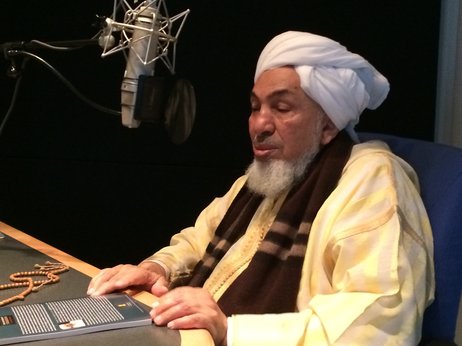
ABB with book

Left: Sh Abdallah Bin Bayyah in the NPR interview linked below with his book The Culture of Terrorism.


More about Abdallah Bin Bayyah here: http://www.npr.org/2014/09/25/351277631/prominent-muslim-sheikh-issues-fatwa-against-isis-violence

I have mentioned before in this blog the perils of translation and the heavy responsibility of those who undertake it, especially with religious texts. Likewise those who prepare texts for publication. This is not unrelated to a book I have been reading, recommended by a friend, called God and Logic, the Caliphate of Reason by John Walbridge, (CUP) He is an American  (protestant) professor of Near Eastern studies in The University of Indiana. It’s about the history of rational thought in the Muslim world. Like a lot of academic writing much of it glides over my head but what I did understand was thought provoking. My first impression is that Professor Walbridge does not really grasp entirely the idea of experiential knowledge and that the intellect is the isthmus between experiential knowledge (like tasting something) and formal knowledge (reasoning something – a subject on which he is expert). In his introduction he rightly points out that for a millenium in the Muslim universe, books were taught by authorised teachers which were hand copied by the student who then taught it to the next generation often with memorisation of entire books. The authority to teach and pass on the knowledge was paramount. Unlike the influential salafi, Muhammad Nasir al-din Albani in the 1960s in Medina, who prided himself on how few ijazas (certificates of authority to teach) he had, if any. The tragedy of the modern Muslim is this notion that you can teach yourself everything from the source texts.

Not till the 18th century did printing begin in the Muslim world to disseminate this knowledge amongst ordinary people. The end result of course is that we have the tragic situation now where any unqualified person with a hadith collection can pronounce fatwas on matters of law etc., and the consequence of course has been a disaster. This was a very potent knowledge and protected by means of the teacher-student chain for a thousand years. The huge and potentially dangerous pharmacy of traditions was suddenly thrown open to any self-medicating lunatic to destroy himself or others, by-passing the doctors who knew how to prescribe medicines from the pharmacy and how to treat sickness. It was like handling and spreading plutonium around the world without its thick protective lead insulation, leading to a subsequent nuclear accident of global proportions. So we can see clearly how powerful books and the texts they contain are and how they impact our lives.

Until I began designing books for a living in the 1980s, I had little interest in books and only almost by accident did I start working with publishers, mainly the Islamic Text Society in Cambridge, and with Brian Keeble, a classic book designer and artist who helped establish a high standard of book design for ITS, like Lane’s Lexicon, Martin Lings’ books and the early editions of the Ihya of Al-Ghazali translations which I worked on. I was hired to help bring their book production into computers as the old photosetting systems and galley proof techniques were being phased out and Brian didn’t wish to have anything to do with these technological changes. I owe a lot to his knowledge of classic typography.

What I didn’t know was that I was being sucked into a new universe of knowledge and words and ideas which the world from which I had emerged had insulated me, and made my previous life seem like that of a dilettante who was happy to read the occasional book on metaphysics, PG Wodehouse and computer manuals. How many times have I seen the narrow book collections of people embedded in sect-like groups, of many different persuasions, who only allow the books of their fearless leader on their book shelves. And how often have I seen the huge libraries of serious scholars.

So books are there and they mean something tremendous but it needs an expert to bring out this knowledge. What I am very aware of now is how the content of the book also needs to be honoured in the quality of its translation if translated, its editing, proof-reading, design, paper quality, binding and so on. It has be an act of faith as much as an act of commerce. I’ve campaigned for this often on this blog. The least we can do is create something of the highest quality and beauty that we can afford.

We don’t live in the middle ages and if printing opened this Pandora’s Box of knowledge then the internet is spraying this knowledge from high-flying aeroplanes. I don’t have the answer to this as the Muslim world is in a massive upheaval right now and only some cool-headed scholars have the means at their disposal to guide it back to some sanity. This is why we can’t easily just return wholesale to hand-inscribed books and one-to-one teaching as of yore. I love hand-calligraphed texts as much as the next man but calligraphy is not only for ornamentation or just hanging on walls. Originally it was for preserving and disseminating knowledge, and writing by hand was the only way you could obtain a book and access its contents.

This diaspora of knowledge by the printed word cannot easily be put back in its box but in a few places the traditional transmission of knowledge is still practised and taught in the manner described above and the effects of that, as it grows, will help to steady the ship. If the corruption of knowledge has been by means of printing and the internet by extension, then we have no choice but to use the same means to restore some sanity to the world of knowledge.
Culture of Terrorism FRONT Cover 2014The publishers Sandala hope to release soon for sale to the public, a valuable text by the venerable scholar Sh. Abdallah bin Bayyah mentioned above, entitled The Culture of Terrorism, which has been sitting in my computer since 2008 but which was recently resurrected and printed in a limited edition for the Sept 25 UN conference on Global Terrorism where Barack Obama made his address, quoting Abdallah bin Bayyah in his speech. When it is released I will do a blog on it.


Posted in language, miscellaneous, Publishing, religion, sacred knowledge, typography / design | 10 Comments

The Sweetest of Music

piano


 then…..

home-design … and now

This post is on a musical subject, so for those whom music is proscribed then look away now. Or maybe not, as you might learn something.

I was recently on the west coast of the USA and was invited by an old friend to give a short lecture to a Community College class on the subject of Music and Islam. She had been teaching a course on Islam to a group of about fifty students, mostly white, in Livermore, a prosperous neighbourhood inland from San Francisco’s Bay Area, the world’s rich crucible of American technology and lifestyle. Teachers like Sh. Hamza Yusuf had also contributed to the course so I could hardly refuse.

These students were average Americans between 18 and 25, not from the super wealthy but from the middle classes who had all driven to college in their own cars. Much of the campus was in fact a car park! I was told that the students mostly stayed for an hour then left so they could get credits for attendance.

I gave a brief account of my life’s involvement with music and how the progression from so-called rock music to North African religious singing was a quite logical progression. At all times, I explained, I was seeking a kind of musical ecstasy, inspiration, uplift….what most people listen to music for. My musical path had led me to the gates of Islam and right on through to the other side up till now, almost 45 years later. But it got interesting when I started to ask the class questions. Who knows what a cassette is? I asked. This drew a complete blank! But the mention of mp3s and Itunes brought a response. When I asked who played a musical instrument, one young man put his hand up. The only hand to be raised. He played the bagpipes! Here we had musical consumers, not re-creators or performers of music. Here there was evidently a generational problem. I wasn’t going to mention the wind-up gramophones of my childhood.

What put me on the spot was when several students asked if we could sing something from Morocco if it was so good. They had called my bluff. So myself and two friends who had come along with me sang a short qasida (song) which we knew in arabic to an up-beat kind of Algerian tune from the desert. Probably hundreds of years old. Much to our surprise they applauded. This was live singing from a living tradition and it had connected with them. But then they asked what the words meant. One of our group obliged. Yet more applause. Most of the students stayed for 2 hours, well past their normal patience thresholds. I was quite moved.

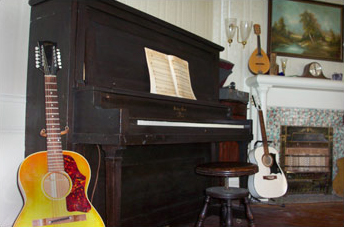
When I was young in the 1950s in the UK, every house probably across the world who had a version of European culture, had a piano in the living room. Rich people had pianolas or grand pianos. Ours was a heavily played wreck of a piano but sufficed for the playing of everything from Gilbert and Sullivan to Beethoven, Bach, Mozart and Schubert via all the popular standards of the 1930s, 40s and 50s. All played from stacks of sheet music on top of the piano. We also had a cello, an oboe, an old guitar, drums and at times a trumpet and an accordion. What mattered is that we played the music ourselves. Records and radio did exist of course but only peripherally. I now frequently enter peoples’ houses that have no musical instruments at all. A sorry state of affairs. But instead they have gigantic TV screens in the living room and Blue Ray players with 4k on its way whatever that is. But no piano and no musical instruments. Consumers of entertainment.

The world uses this wonderful technology to watch movies with expensive soundtracks – the obligatory musical accompaniment to the film director’s dream. A film without music is interesting as it is almost emotionless with only dialogue and the story line producing any kind of emotional response from within the viewer. I did a few not very notable soundtracks for documentary films in the 1990s and it amazed me how a film could be transformed by music. A functional sequence about cutting marble could be turned into a great drama or a comedy, purely by the choice of music. The film of Dracula could easily be turned into a slapstick comedy by the use of a Laurel and Hardy music track and vice versa. I’m naturally interested, ergo, in what the musical sound track is for the most important of films – my own life, the film I am in. So should everyone. Is it other peoples’ music or is it yours? Is there no music or singing to the film of your life and why not?

I disagree strongly with those religious folk who say music is forbidden. There’s beautiful music, good music and ugly, bad music. But people have to choose. What scholars and theologians dispute about is their business and they have been doing so forever and that’s to be expected. But banning music is like banning speech because some people use profanities. Absurd. The people of extremes, and we all know who I am talking about, will next pick on music and start beheading rock stars. It could happen. Well if it was within my power to forbid certain kinds of music I have many genres I would gladly prohibit. But it is not, and probably better I don’t have such a power. Loud throbbing, mindless trance music which sometimes percolates up our valley for days on end is top of that list. There’s something hellish about it.

But the ever present noise of the mechanical world from chain saws, the radio next door, helicopters, jet planes to loud PA systems is just a reminder of this crazy machine addicted world where people have been imprisoned in a kind of feudal technological universe where they cannot think or live outside the box they have been put in and use and tolerate noisy machines just because they are there. Can’t we ever just say no?

Making your own singing and music (without huge amplification please) is one place you can find out a lot about yourself and find unimagined harmony and beauty that will benefit you and your family for the rest of their lives. All yours and all free. And then after that comes the sweetest music of all – silence with nothing but the breeze and the sounds of bird song.

Posted in miscellaneous, music, religion, sacred knowledge, Uncategorized | 7 Comments

Moronic Iconic


I have always thought Jonathan Meades’ scathing criticism of the casual use of the word iconic amply justified. I suspect there are many things he, a well known British writer, critic and film maker, and me, would disagree on, but on this we hi-five. The word icon means, in Greek, an image, and it has flooded into general use in English by the universal implementation of icons in computers over the past 30 years. And probably why the word iconic has crept into common usage everywhere on the back of this.
 Blog icon
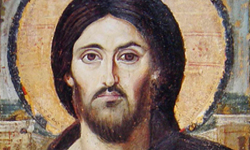
Of late I have found my mobile computer screens cluttered with pesky skeuomorphic icons all vying for my attention and rather than just referencing an alphabetic list I’m wandering over muliple pages trying to find what I want…and it’s confusing. A few icons are useful but above that few it starts to become like Chinese with its 50,000+ characters. At least with Chinese it is mostly in one colour with a kind of linguistic system to it. With computer icons the eye is fighting to recognise different colours, shapes and also where the hell you dragged it to last time you rearranged the screen. Now when the word iconic is invoked we have entered another world of the spiritualisation or sanctification of an object. It’s almost like deifying a picture, a photo for instance, or an object like a piece of technology into something greater than what it is and a misuse of the word and an abuse of language. Or maybe it is just a lack of vocabulary I’m not sure, but whenever I hear the word iconic I wince and avoid it if at all possible. Symbol is maybe a better word choice in my opinion than icon for general use as it doesn’t imply sanctification.icons Religious icons were used historically in Eastern Christianity as devotional aids but escaped religious censure as graven images by being two dimensional with a strict limit on bas-relief i.e. how much the design could be raised above the picture surface (very little). Also the subjects of the icons were often Jesus, his mother Mary or the current Emperor of the time. Ordinary people were not allowed to be pictured as icons which would be a pretty hard call for the snap-happy modern human. Not much of a market for cameras in Eastern Christianity.Of course Muslim and Judaic law proscribed the use of human and natural forms completely, their places of worship adorned only with holy script and designs other than those depicting living natural forms. This does put photography, which we all use, into an awkward category. But the defence that it is just a ‘frozen’ reflection, not a created image, lets it off the hook to a degree. My jury is still out on that one as like most things involved with making a copy of a real object, a sound or a moving thing, it creates all kinds of difficulties as it is the mimicing and dilution of an original reality. I’ve discussed this in a previous post, Flight from the Real. (I think)

So there might well be some unconscious religious impulse in ‘iconising’ images and objects in this post post-modern world. Humans are worshipping creatures by default. I’m fully well aware of this in the idea of a logo, a few of which I have had to create professionally over the years. A logo is an icon of sorts, i.e. an image, but hardly one which is of devotional significance, consciously worshipped. A logo is generally used in a heraldic sense to display a regiment, a team, a business, a club, a college, a cause, a country or a manufacturer. At times it can verge on idolatry but on the whole not – maybe just ardent love. After all, the general public display openly their loyalty to a football team, a techno product, a city, a cause…you name it. A natural statement of loyalty or maybe just choice. But its purpose is not intended for worship. The flag (a logo by another name), the coat of arms, the banner were used all through history by the Europeans, the Japanese, the Chinese, just about everyone and I hardly think they were objects of worship but just a way to be identified and recognised.

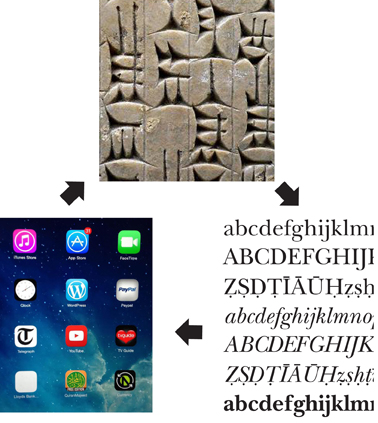
RAFInterestingly, in arial warfare of the 20th century, pilots would not identify enemy aeroplanes by their country’s insignia as there was never time or sufficient proximity, but by shape alone. Just as well, as the RAF insignia displayed here looks like a target to me awaiting a pot shot. So in the arial warfare example we return to the use of an outline shape, like an alphabetic letter, which is of course much quicker and easier to discern than a coloured icon. It’s called lettering or print! The phonetic alphabets as pioneered by the Phoenicians were a huge advance over cuneiform pictograms, as it enabled an almost infinite way of combining vocal sounds and meanings in graphic form. Phonetic images in other words. It still mystifies me how such hugely developed countries like China, Japan and Korea never abandoned pictograms in favour of alphabets.

So Mr Samsung, Mr. Apple and co., please give me the option of just an alphabetic list, A to Z on my mobile screens like an old fashioned desktop computer instead of multi coloured icons. A Table of Contents! That way I could see everything I needed on one screen and find what I want quickly and alphabetically. It’s a wonderful thing, an alphabet.


Posted in language, miscellaneous, religion, sacred knowledge, typography / design, Uncategorized | Leave a comment

Pixel Imperfect

pixel man
When computers took over most design offices all over the world in the 1980s, there was a seismic shift in the way that ideas conceived by designers were drawn and constructed. CAD (computer aided design) enabled  an accuracy of seven decimal places which though useful in the exacting world of engineering, was absurdly accurate for traditional design and construction where tolerances of a pencil width was about as fine as it went. Till the 1980s there had been no need for extremely fine tolerances in architecture and the graphic arts and this didn’t prevent the creation of beautiful long lasting works of art and architecture. The introduction of this kind of numerical exactness affected everything. It was the beginning of a particularly nasty kind of intolerance and heralded an era in which people began to believe in the necessity of absolute exactness in all things. Obsessively.

pencil

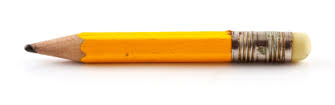
Let me explain myself. In the old days, which I knew quite well, a line was drawn on a drawing board with a pencil which had an effective width which corresponded to the normal tolerances of an actual building site. In other words if you drew a line on a piece of paper with a pencil it correspond to approximately a quarter inch or less on the ground depending on the scale of the drawing. Any builder would work within certain parameters in which slight dimensional variations did not matter. But this was when buildings were built in traditional ways and they still got built successfully. The more buildings were pre-fabricated the higher the tolerances. Now on site laser technology has permitted all kinds of construction to very high tolerances. More and more buildings are assembled from components and not crafted on site. I question whether this was humanly a good thing. Architects have increasingly become specifiers not designers.

JOBS FOSTER

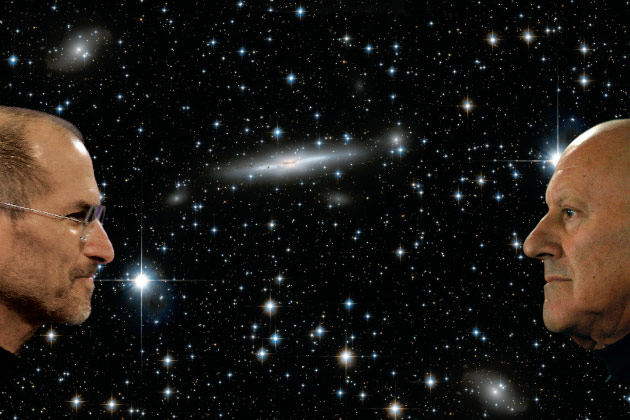
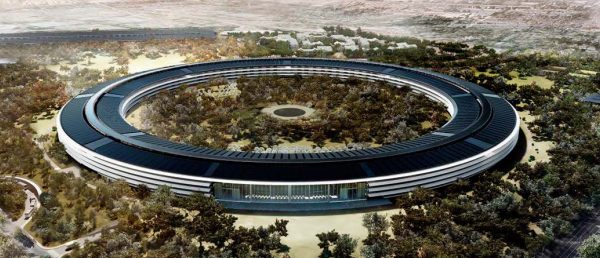
Fast forward to 2014 with the new Apple HQ doughnut http://www.wired.com/2013/11/a-glimpse-into-apples-crazy-new-spaceship-headquarters/#slideid-312441 being built in Cupertino in Silicon Valley. Designed by Foster Associates it will house more than 13,000 workers and will be constructed to incredibly high technical tolerances as if it were an aeroplane or a watch. Why? Just a fanatic Jobsean excess? Foster-Jobs: a meeting of two obsessives on a grand scale. Foster buildings are like Apple computers writ large.

Apple-HQ-2.b

Maybe this is why so many of Foster’s buildings look like machines because from early on they were using CAD programs (on Apple Macs of course) and like it or not their many designs, like Stansted Airport, the Berlin Reichstag etc.,  ended up looking like, er…computers…all sleek and titanium grey with lots of machine motifs, no arches, few curves, no ornamentation, glorifying steel and glass and rationalising it with worn out phrases like “A building is Machine for living in”. Who wants to live in a machine? Evidently quite a few people, and pay a lot of money for it. Aside from Foster’s rationale it is, let’s face it, just a style and like all things modern sometimes good but so often predictably bland and may well pass into history as a period of strange human obsession with grey metal.

Anyone who has designed a building, a book or a even a piece of furniture knows that the process of design is intimately connected to the end result. I’m not saying using the computer to design a building is a bad thing but just to say it preconditions the outcome and we should be aware of this. The builders of the great cathedrals and mosques must have had a method of drawing and planning but it was just the means to the end i.e. the building. You do wonder with the modern movement in design if the computer isn’t dictating more than it is being dictated to. I remember Paul Luna of Oxford University Press saying over 20 years ago in a seminar I attended on desktop publishing that the computer is not a tool but an escalator which we have stepped on to and are bound to go where it leads us. Too true.

I’m sure I’m not alone in thinking that the drawing board discouraged many an architect or designer from using curves as they required a lot more draughtsmanship. Right angles and straight lines were easy. Some historians have blamed the use of industrialised building construction for the rectilinear design of ‘modern’ buildings as manufacturing things like arches were not machine friendly. Others dispute this and cite cubism and constructivism as an art style of the time which also influenced architects and other designers. Chicken or egg, it doesn’t really matter. The days when arches or domes were necessary to span large distance were gone. Reinforced concrete and steel frames rendered traditional building methods void virtually overnight as you could pretty much span any space with steel and concrete. That is a bit of a simplification but you get my point.

What interests me now is how our processes of creating anything affect us in profound ways and how the use of anything mechanical or electronic affects us in very profound ways. The drawing board or the sewing machine or even the typewriter historically impacted our behaviour, but the computer raised the bar to undreamed of heights. Because a computer gives you unprecedented control over a firstly a virtual reality and then over actual reality this has to affect behaviour. Many times I’ve been told by my wife how intolerant I used to be when working at a computer. It did subtly affect my behaviour although I have learnt in twenty five years of computer use how to keep it at arms length. The notion of ‘delete’ or ‘reboot’ translates into real life generally in a negative way so people become impatient and look to solve their problems with a keystroke! But real life doesn’t work like that as we all know.

drone control  AIR_Raytheon_UAV_Universal_Control_System_lg

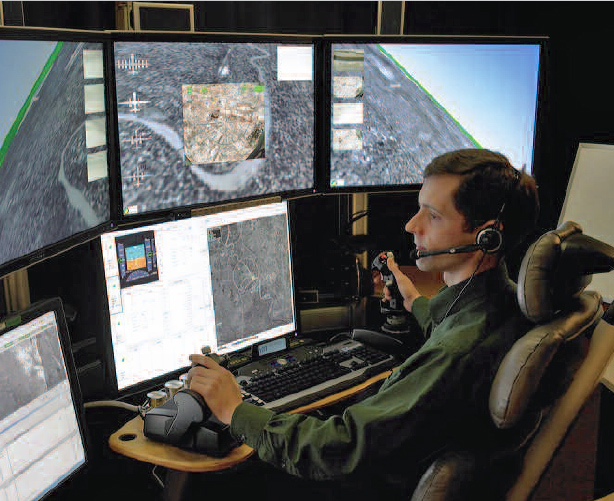
So heaven knows how violent computer games backfeed into the gamer although all the gamers deny it. It makes the idea of a computer operator in Nevada or Lincolnshire controlling a drone over the Northwest frontier blowing away enemy targets a frightening concept and why such people are prone to severe depression and trauma. When the missile is fired someone actually presses a key… Which key is it? The delete human key? The human soul cannot endure such things even though it be virtualised on a computer screen, unless it is brainwashed or even drugged into doing it – which is the way a modern army trains it’s soldiers of course. Not much chivalry there. Significantly I think computer use has also made people demand irrational levels of accuracy in the belief that numerical exactness is a substitute for something just looking good. Which is the point of this essay. In my own work I often just sketch on paper, then guess things optically on screen and then if necessary tidy it up using computer tools. Do we really need  to be pixel perfect? Whatever next? Molecular nano-accuracy?

So where does that leave us? The great beast of the internet and its billions of computers is something we have to accept as it is not going away and a beast which we either ride or end up being crushed by, like the bull-runners of Pamplona. This means being able to take from the machines what benefits and also being able to leave them at will. It’s as simple as knowing when to walk rather than drive in your car. Or write with a pen or pencil rather than picking up the laptop. Machines are there to assist you or humiliate you. What kind of man rails against technology as a satanic conspiracy (and I know a few) and then gets in his car having received a call from his wife on his mobile phone. Technology is a kind of crutch for the disabled but that is our condition – sadly.

Posted in typography / design | Leave a comment

A Meaty Subject

I’ve given up writing comments on newspaper web sites as a waste of time. It’s just a way of readers, me included, venting their spleen and as currently I can’t think of anything to contribute on my chosen subject of design or typesetting, I thought I would write something informative on a meaty topic like halal slaughter.

Image

I would safely say that 99% of the politicians, journalists and ordinary folk who have spouted forth on this subject have probably had very little to do with actual sheep, let alone killing them in a religious fashion with a sharp knife. It looks to me from the outside like a politically inspired piece of hot air designed to whip up resentment about “the other” in the forthcoming European and British general elections. So this is where I come in.

Although I haven’t sacrificed a sheep or chicken for years now I have done several in the past and it qualifies me to talk about this with some experience. Very simply it means taking the animal or bird and with some care to keep it away from others of its kind so it feels no fear, and applying a very sharp knife across the jugulars. The short prayer uttered is a reminder that you are taking life with divine permission and that one day your own life will be taken from you by the One who granted it to you in the first place. The nerves to the brain are instantly severed so there is no pain as far as we know.* This is ascertained from our knowledge of the nervous system and seems pretty likely. Until we have a sheep or chicken to testify in public to this of course we shall never know. The sheep immediately loses consciousness and doesn’t “bleed to death”– the emotive description I have read in the UK papers. It bleeds, yes, but that is not how it dies.

Bleeding also purifies the meat of any toxins like adrenalin which stunning and fear produces and which locks them into the flesh and which is present in all stunned meat, probably even the pre-stunned halal kind. Veterinary laws in most countries insist on the bleeding of specifically pigs as the blood contains toxins lethal to humans and which is why in the UK it is illegal to kill a pig on your own land for this reason. Not so in Spain though, where pigs are routinely killed by small farmers in their own back yard often on what is called the Matanza, a kind of national fiesta of blood and gore. Also few country people in Spain don’t know how to dispatch a rabbit in seconds. In contrast city dwellers and supermarket shoppers in the countryside have no connection to the meat they eat other than shovelling it into their insides without a second thought.

How we care for our fauna and flora is at the heart of all these arguments about food laws, as this affects us deeply, both physically and morally. So whether meat is technically halal or not is irrelevant if the animal has been raised in an unnatural way. The same applies to food grown in the earth. Forcing plants and animals with chemicals, genetics or unnatural environments like battery farms for purely financial advantage is a very shortsighted and dangerous policy. For how we care for the flora and fauna is how we care for ourselves. It is perfect mirror of the humans set in charge of them, and the results of altering natural patterns of husbandry means sickness of body and soul. Seguro.

There is a skill in halal animal killing and it has to be learnt. This was a time-honoured practice of all the Abrahamic religions which means for many thousands of years this has always been the practice. We have inherited most of our accepted moral law from this tradition (ie the Ten Commandments) so why is this different for modern man? The modern neurosis about animal slaughter is the result of industrialisation, not of some hatred of religion. I say this because it is likely that even in older Christian and pre-Christian societies animals were killed with a knife to the throat as it is the easiest way to kill a beast. A local non-muslim sheep farmer I know kills all his sheep this way as it is the easiest and quickest way to do it. Industrial farming and marketing of meat forces the use of production line killing–even with so-called halal slaughter. The arguments put forward by some Muslim intelligencia that it is better to eat organic non-halal meat than industrial halal meat also doesn’t hold water. You still end up with meat filled with blood poisons like adrenalin locked into the meat. So how do we get out of this bloody mess?

So long as meat is over-consumed and demands industrial processes this conundrum won’t go away. Muslims, especially in the Middle East, consume far too much meat anyway, ignoring the Prophetic advice not to make their stomachs the graveyard of animals. Meat for breakfast, lunch, dinner and probably a snack in between. I can’t speak for Jews. The health consequences of this should not be ignored as diabetes and obesity is engulfing the prosperous parts of the Muslim world where ordinary folk are fighting a losing battle against an avalanche of sugar and meat consumption and lack of exercise. And who speaks for the 59 billion animals alive at any given time on earth, being raised for our consumption?**

I sincerely believe that the current row about halal and haram meat is utterly false from both sides of the argument and appears to be political and uninformed of the facts I have volunteered above.***  It all seems motivated by the clarion call of agribusiness, scientists and their political front men, that we have to produce more and more food to survive by fair means or foul, justifying all the horrendous practices of greedy farmers and supermarkets. But to what end, when not only is so much food wasted but also so many people just over-consume? I can’t help feeling that what humans face is a moral problem not a food problem. Learning to eat less would promote our own health as well as the health of our animals and crops. This is a choice humans are empowered to make. Take away the demand and the supply chain is immediately affected. Then animals can do what they do best which is to roam around fields and hills happily munching their lives away and our cereals and vegetables can grow in a non-chemical earth, left to grow in peace.

Finally I am waiting for the first food store to remove its “organic” labels and re-label all processed, chemically altered food as such and to erect clear aisle signs saying “Processed and Unnaturally Produced Foodstuffs”! Pre 1960 in the UK everything was organic – so what happened? How about labelling all stunned meat – halal or not?

*A study in Germany in 1974 at the Hanover School of veterinary medicine concluded that bolt stunning is painful to the animal.

** See the book Planet Carnivore by Alex Renton.

*** Historically the political campaigns and laws against kosher sacrifice in Europe and Scandinavia is believed to have its roots in anti-semitism more than considerations of animal welfare.


Posted in miscellaneous, religion, sacred knowledge | 1 Comment

Arabic typesetting revisited

nounou14

Hand written naskh (by Ibrahim Khattat – Iraq 20th century)

My involvement with arabic has always been, for over 40 years, essentially calligraphic and I have always disliked the idea of trying to mechanise an essentially hand written script.  But the practical demands of publishing in the modern world has meant making a kind of a rapprochement which has meant accepting its use. But it comes at a cost.

When Egypt became the media centre of the Muslim world after the fall of the Ottoman Empire in the 1920s it established modes in the typesetting of books, manuals, newspapers etc., which flooded the Arabic speaking world and beyond. The script of choice to accomplish this was naskh which was the prominent style for text amongst arabic calligraphers everywhere. At that time printing was universally letterpress moveable type with words (and spaces), hand composed from minute blocks of metal, which was a very time consuming process but necessary for printing to be possible. The history of arabic typesetting is quite interesting as the first attempts were actually made in Italy as long ago as the 17th century, and not in the arabic speaking world. You can read an in-depth article on this by Paul Lunde in an Aramco World article from 1981. (see link below) You see in his study the political and religious import of printing and its part in the fall of the Ottomans and the rise of the west. Also how printed arabic made available treatises on science to the west which were lost when great libraries of places like Baghdad and Cordoba, with its millions of handwritten texts, were destroyed by the Mongols and the Spanish Catholics. See this article:
http://www.saudiaramcoworld.com/issue/198102/arabic.and.the.art.of.printing-a.special.section.htm

There were calligraphic variations in naskh even though the great Ottoman khatats of the time had resolved the handwritten script into an almost typographic uniformity, but beautiful as well.  It is known that in the time of the Ottomans, a whole book could be handwritten by a group of calligraphers dividing it into sections but with indistinguishable styles of writing in naskh script. In Ottoman days I am told you could get a book expertly copied by a team of calligraphers like a giant human photocopying machine and have it bound and illuminated for a bit extra. So it was logical to develop the naskh style into a typeface. I may have mentioned in earlier posts about the Daily Jang, an Urdu daily newspaper produced in a London. In the 1980s I was working for an advertising agency and our main banking client required a newspaper ad in Urdu. I found a calligrapher to do it who had just lost his job as a calligrapher producing along with many, possibly a hundred other calligraphers, the whole Daily Jang, Pakistan’s major daily newspaper produced in London, traditionally by hand. The newspaper had installed computer typesetting and laid most of them off.

In the world of Roman type there are literally tens of thousands of typefaces. These styles reflect a whole history of western lettering styles going back over 500 years. The varieties of Arabic scripts are minute by comparison and this is reflected in the relatively few arabic typefaces available even with the proliferation of computer use. Some say this was because of rampant piracy but also because there was no escaping the fact that anything but the traditional styles were unutterably ugly.

Despite this vast cornucopia of type possibilities I have reduced my own choice of both Arabic and Roman faces these days to about three or four for various reasons. Beauty, legibility, printability etc all come into play because this all adds up to what is easy to read and communicate the author’s message accurately and with least effort. Good typesetting is often described as being invisible i.e. that it doesn’t get in the way.

Pickthall 2

Pickthall 1

Pickthall’s 1930 Hyderabad Edition hand set in metal moveable type.

Arabic typesetting has a complex history, as a cursive script with many links and variations that occur in Arabic, requires many more elements to be combined together than Roman text. With hand composed metal type this is very complicated and resulted in as many as a hundred and fifty separate elements once you start to include all the various Arabic ligatures, connections and vowels. So the early Arabic typefaces were simple iterations of naskh and actually very good although not able to deal with the flexibility that hand calligraphy allowed. The Hyderabad Pickthall translation of Quran first published in 1930 (see above) used a hand composed metal naskh typeface which was for for many years a workable Arabic print face and was not improved upon until the coming of firstly hot metal composers, then photo-setting and later computer setting in the 1980s. It has now reached incredible levels of sophistication albeit still limited by the fact that it had to be input from a keyboard.

All this compelled IBM in the 1950s to try and create, with the help of Nasri Khattar a well established calligrapher and designer, an Arabic face based on discrete glyphs (ie not joined up) so that it would fit their 256 ASCII character set based upon the qwerty keyboard. This experiment mercifully failed as it would have violated so much of the script and what was well established over the vast expanse of time, since the first complete Qur’an texts which had been written down in pen and ink on vellum. This would have been an aberration too far. See http://29letters.wordpress.com/2013/07/29/ua-neo-fonts/

The few Arabic faces I use when there is no possibility of hand calligraphy, are stylistically limited but suffice. One of them, Decotype naskh was an attempt to mimic the way a calligrapher writes although some find it a little difficult to read. Thomas Milo, a Dutchman, who was once a gun-toting United Nations worker in the Lebanon, who created this, originally intended it to be used with its own software engine and was very effective but it got dumbed down somewhat when it appeared as a standard font on Mac and PC platforms in the 1990s as it had to bypass its natural variations from the base line. In other words it became more or less a linear script which naskh is not. (see the illustration at the top) Milo’s Tasmeem plug-in for Indesign mitigated some of these shortcomings, but who has the time to fiddle with text in this way? If you want calligraphy get a calligrapher. Another face I use is Linotype Lotus which began on PCs over thirty years ago and which is one of the best non-calligraphic faces but lacks certain important characters if you set Qur’anic text. A few more pass muster like Karim LT but as for the rest they are mostly abominations reflecting Arab designers’ modernistic tastes. One compromise I have made which works, is to mix hand calligraphed Arabic for titles with typeset blocks of text. Many Arabic newspapers and magazines used to do this.

My rapprochement with typeset Arabic is not unconnected with my view of the early Arabic scripts which were unselfconsciously the vessels of knowledge, its translation and dissemination, and not made for artistic merit although with implicit and unself-conscious beauty. These days if all Arabic writing was by hand the dissemination of knowledge would be severely impaired. But this does not diminish my gut feeling that typeset Arabic is not a substitute for writing by hand and all its many secrets.

In the madrassas of India, I am told that the teachers still prefer to teach from hand written lithographs rather than printed texts. There is an understanding of the deep connection of handwritten letters, learning and religious knowledge and the recent understanding that the human brain responds profoundly to hand written right left writing. God taught by the pen, not by the computer.

Posted in language, miscellaneous, Publishing, typography / design, Uncategorized | Leave a comment

Mending fences, chasing demons.

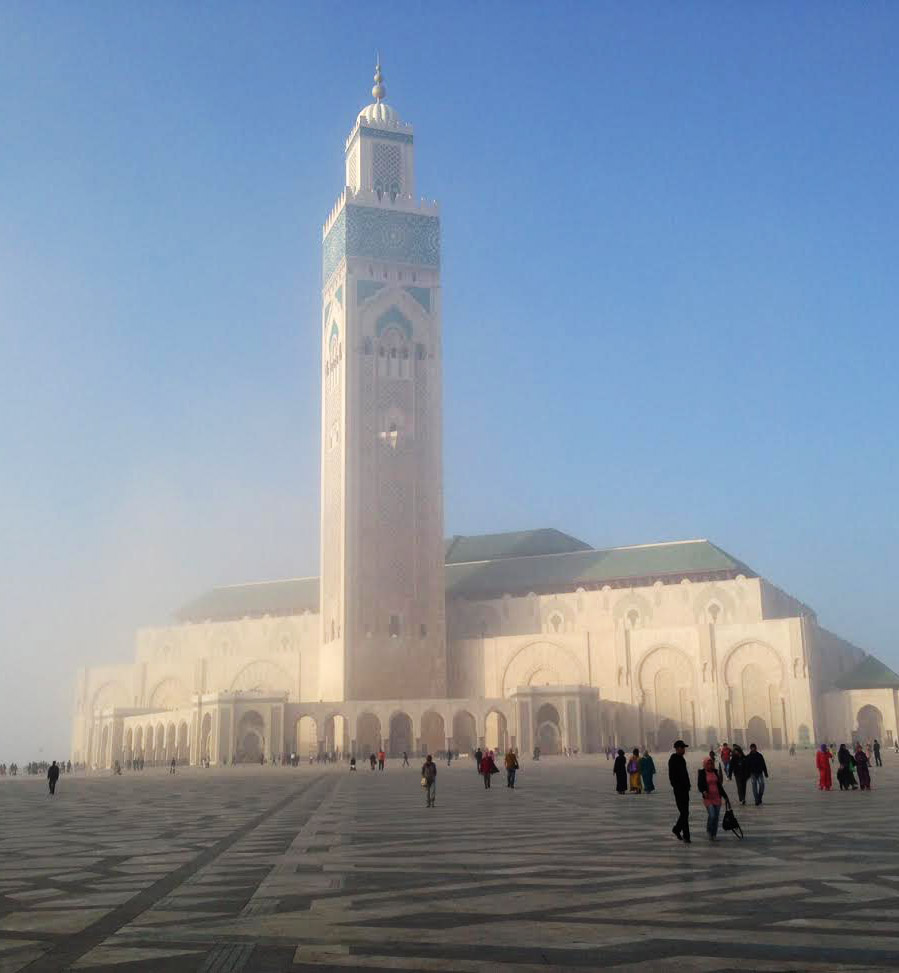
Hassan 11 mosqueI have just returned from a few days filming in Morocco which was an attempt to revisit the time myself and a bunch of young white English and American men and women first visited a venerable Sufi master and his people in the medieval city of Meknes over 42 years ago. I believe the film is an attempt by the producer to find out why and how it all happened and why such people, from often privileged and educated backgrounds, would go against the Christian and patrician grain of English society of the time and embark on what was, ostensibly, such a difficult journey.

The film, which is being shot in several countries, is also trying to trace the history of this nascent community in England, it’s successes and failures and why after ten years it started to fall apart. Any such documentary was likely to look under the scabs of old wounds and to see if there was any way some fences could be mended and some demons expunged. I’m not holding my breath, as rebuilding trust after a divorce is well nigh impossible; but the children of the marriage, the next generation, have a chance if it fully understands what happened and then re-buries the corpse after the post-mortem. Then I think we could all breathe a little bit easier. Some oxygen pumped into this stagnant pond wouldn’t be a bad idea. And I’m saying this to all concerned. Let’s see if the director has the courage not to sterilise the story and cut out the uncomfortable bits of the movie.

I’m tapping this post in Casablanca airport having been snared by failing to check-in at Terminal 1 in time (they closed it an hour before the flight!) and then change to Terminal 2 to catch the plane. Shades of Lauren Bacall and Humphrey Bogart who also had a few problems at this airport. So I had 24 hours to have a quick shufti of this sprawling city, Morocco’s slightly grubby commercial capital.

Initially the traffic in Casa is quite alarming, as cars, pedestrians and carts of vegetables and chickens seem to have independent ideas of who owns the road. But now I believe there is some kind of invisible angelic bubble wrap allowing cars to bounce off each other without actually colliding. Not once did I see a collision, though every minute it seemed inevitable. I also had a quick peep at the enormous Hassan II mosque on the sea shore, enshrouded in a mysterious sea mist, with hundreds of Sunday strollers wandering across its vast concourse. Nice, but a few trees and seats wouldn’t have gone amiss. (see pic above)

My drive to the airport from Meknes was with a fine young Morrocan from the family of the big shaykh we first met all those years ago. He explained in good English how this generation of westerners and Moroccans too, have a confusion with simple word definitions. One of these is the word shaykh which young zealous Muslims get confused about. He said that to a Moroccan,  anyone who is your teacher is your shaykh (often the father of the family) and oddly how certain notable men of high repute in recent times have refused the appellation shaykh even though others would address them as such and wish them to be it. This is why I find it faintly amusing when I get emails addressed to shaykh Ian. I have white hair but shaykh? – I don’t think so. A bloke I will always remain.  Also when a teacher is a master of any discipline he would rightly be called a shaykh as a term of respect. A man or woman might have many shaykhs or teachers. The problems start when a man or woman claims this title as if it bequeaths some divine right of unchallengeable authority, which of course it doesn’t.

We are not a people of claims
The words of an eminent Moroccan scholar.

Morocco remains a place of wonders after all these years and certainly where you learn the true meaning of qabd and bast. (The divine contraction and expansion of the heart).

Last thought: why do travellers in the third world have such enormous suitcases?

Posted in miscellaneous, religion, sacred knowledge, tassawuf, Uncategorized | Leave a comment

Self-publish and be Blessed

sugich

Self-publishing is a topic which flies about the publishing world like helicopters fly around the valley I live in, seemingly never to land. I do see the attraction to a wannabe writer to fork out not very much money and have his or hers masterpiece in his or her hand and it is an idea that is gaining traction. Self-publishing is intrinsically tied up with print on demand or POD as it is acronymed, which enables print runs of one or a thousand as required using laser printing technology. I designed a whole series of books for American poet Daniel Moore between 2005 and 2009, using lulu.com which was a solution to the problem of laying out a lot of cash for a run of books that you had to store and then sell — every publisher’s headache. Furthermore lulu distributed the book and provided the bar codes etc. and got it out on distributor’s lists. Fine so far, but the end result was rather disappointing for me who had been for many years been working with litho printers using beautiful book-wove papers nicely bound with properly sewn sections etc., trying to improve and refine book production. Lulu also limited the self publisher to just a few size formats. It was like eating badly cooked food.

Seeing poetry laser printed on white photocopy quality paper and a cover with automated spine lettering, with cut and glued page sections was a let down indeed. To me printed poetry (and anything else of quality come to that) demands quality typography, quality paper stock, good binding, etc etc., as it is intrinsically part of the magic of the printed word. It proves the author and the publisher believe in their book and want to honour it. It’s as if the smell and touch of the paper are inseparably part of the poem or whatever. It’s all about quality, not quantity and economy. The difference between say an email and a handwritten letter. This is the reason why to me, a poem read on an internet page doesn’t excite in the same way as in the kind of book I describe above. Maybe there is a kind of poem that would suit the internet but I’m not sure what that is. A koan? Maybe a tweet? Poems for limited attention spans. 140 characters.

But things have changed since the early lulu.com experience. I have now sourced quite a few traditional book printers who have now entered the self publishing field and now offer quality books with best papers, binding etc., in all size formats with bar codes and distribution thrown in. You pay more for sewn sections and better paper but not much more and the end result is well worth it. If every author or poet knew how this extra care taken increases the book’s impact, the few extra dollars always looks like a good investment. Not to mention that the book will last a lot longer.

A good American friend of mine, Michael Sugich, has recently dived into this arena having self published his book, Signs on the Horizon, (illustrated above) about his encounters with remarkable Muslim saints over the last 40 years. With my book designers hat on I naturally had serious professional criticisms but strangely the content of the book shone through strongly and its technical and design faults seemed to fade into the background. It was produced using Clearspace.com a Jeff Bezos Amazon company designed to hammer yet another nail in the booksellers’ and publishers’ coffin. Another client of mine in the USA used Clearspace to do a quick pre-print run of a book and I encountered some of Clearspace’s requirements which seemed quite absurd. Eg. requiring a huge inner text margin of 0.75″, a space necessary to avoid the “pinch” when the pages are folded, cut and glued creating a tight book that doesn’t open easily and which is always in danger of bursting when the glue gives out. But it obviously caters for a sector of the market. Although actually ultimately serving Jeff Bezos’s bottom line.

Clearspace looks very much like lulu.com repackaged with the added benefit of Amazon’s goliath like muscle with it’s admittedly efficient book distribution network. I’m told the author gets 35% of the sale which is far more than traditional publishing royalties. So not all bad. But a big publisher has marketing muscle which the self-publisher does not have. This is the argument they use to discourage the self-publisher of course. Self-marketing is the next frontier to free the individual publisher from the old world of publicists and their cosy relationships with broadcasters, news media, advertisers and so on. But what shape that will take I am still waiting on. The internet has changed everything.

By the same token I am disappointed with ebooks which return books to a kind of anarchy where you choose the font, the size etc which although has its uses goes just a step too far. Curiously I read the other day that a man who suffered from dyslexia all his life found that by ranging all the text left in an ebook he could read easily as all the inter word spaces were equal. This may not be the cause of all dyslexia but it’s worth noting. Also for those with difficulty reading like children or old people being able to enlarge the text you can see the advantage.

But I return to my protestations about dumbing down the book because the origins of knowledge are intertwined with the idea of writing, pages and books. These are the metaphors used in revelation and why we have to honour more than we do the almost sacred nature of how we convey and preserve words and language on paper (or by electronic means come to that).

In my job I’m always looking for the perfect book with a perfect marriage of content, design and printing, with paper that will last for hundreds of years (sewn sections, acid free book wove, high rag content etc). Because when the hard drives and the sold state memory banks of the world of stored knowledge and information give out there will be something of quality left to read. Who knows, vellum might make a come back one day as it outlast everything short of carving into granite.

PS There are very good alternatives to Amazon who I have got tired of and who at the time of writing are about to be exposed by a BBC Panorama programme as running what looks like exploitative and inhuman working conditions for their workers. I just used Books etc., which went well. They also enable you to sell your own books at a cut of 15% to them. When I was last selling books though Amazon they were taking 60%!  The public’s hatred of Ryanair, the Irish cheapo airline, has been so intense of late that they have en masse gone elsewhere and directly contributed to a second profits warning for Ryanair this year. Now for Amazon. It’s time we realised that the Amazon maybe the biggest river in the world but is full of piranhas.

Posted in typography / design | 3 Comments

From Mods to Mecca

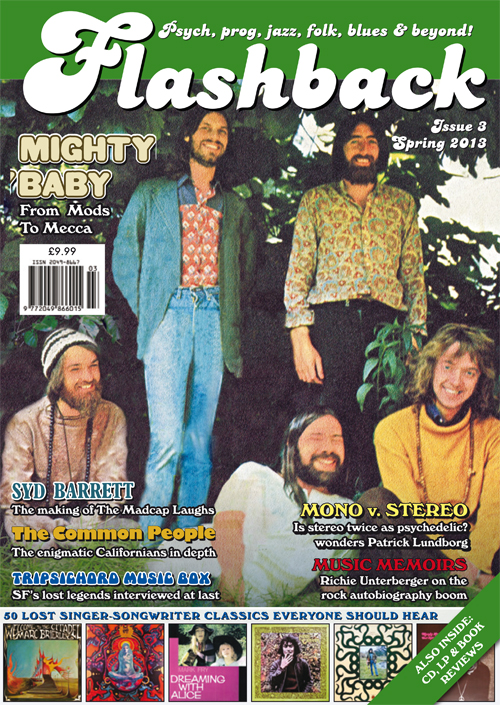
Nostalgia has always been big business. Look how the Victorians ached for a romantic gothic past and the Edwardians for a rapidly disappearing bucolic world with the arts and crafts revival. To find my own past the subject of a nostalgic movement was for me a bit of a curiosity as earlier this year saw the release of Flashback (3rd edition), a magazine for folks for whom late 1960s prog rock was a great forgotten period of British music.

Flashback_Issue 3_Spring 2013

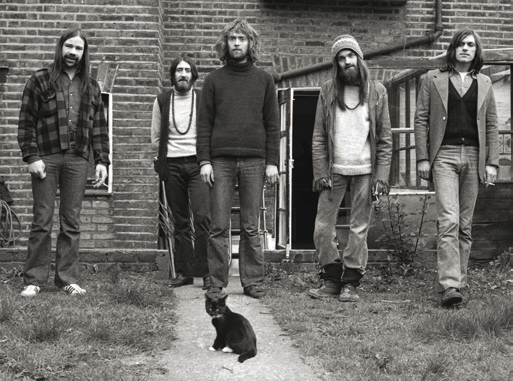
Its featured article was entitled, eye-catchingly, from Mods to Mecca. This arcane genre of music is not necessarily the realm of bald headed,  grey haired freaks, but apparently  people of all ages (mostly blokes I imagine). Richard Morton Jack, an Old Etonian who is in his early 30s, publishes the magazine dedicated to this prog rock period from about 1967-73 and wrote From Mods to Mecca a 39 page feature about my erstwhile friends and co-musicians of the rock group Mighty Baby which was born in 1967 out of the ashes of the great London 60s mod band The Action. Mighty Baby floundered in 1971 for many reasons which the article describes in detail.

Aside from whether you like the music, (you don’t have to) it’s an unusual story of how a group of musicians of mixed English backgrounds (middle and working class) met up in 1967 and after a jolly few years playing music just about everywhere and with everyone, ended up with firstly a real Sufi brotherhood in North Africa, meeting one of the truly great muslim saints of the 20th century, and subsequently going on the pilgrimage to Mekka. (Well three fifths made that journey.) The article, richly illustrated with photos and newspaper cuttings, is 99% accurate, historically speaking, unlike previous histories which were pretty fictitious and incomplete. Richard Morton Jack dug up things I had completely forgotten about and found photos I had never seen before. The band’s music was also featured in May this year on Stuart Macone’s BBC radio 6 show called appropriately The Freakier Zone.

To the establishment you can’t mention things like Glastonbury or names like Jimi Hendrix or George Martin in the same breath (or article in this case) as Islam and the Haj or Sufi shaykhs. Almost like oil and water. But Richard Morton Jack courageously tells the whole story and leaves the reader to judge for himself. I say the establishment, because when Cat Stevens was embraced by Islam (it’s interesting to phrase it that way round), the UK establishment did their best to slaughter him. Though well intended, Yusuf put his head too far above the parapet and just didn’t have enough media savvy to deal with it, but also Islam, the religion. was something not wanted in the public discourse as something rational and an option to be considered by ordinary people. So at every opportunity journalists (the voices of the ruling establishment) set out to trap him and resurrect all the old canards about oppression of women, the Satanic Verses issue, jihad and so on. I was personally present at a live BBC radio interview with Nicky Campbell, about Yusuf’s Bosnia War CD when his opening question to Yusuf was “how can you follow a religion that condones the rape of women?”  This gives you an idea of the deep seated hatred and ignorance of anything to do with Islam that is dormant in the British psyche and which I believe goes back to colonialist times when the British were heavily brainwashed against the Turks, Arabs. Africans et alia, just about everyone the British were colonising and whose lands they were plundering in the name of Christianity and progress. That’s another story but is the background to the Mods to Mecca narrative.

mb monmouth rd

Photo by the late Keith Morris 1971.  

To me it still seems impossible now, in fact almost miraculous, that this was to be our destiny – from just itinerant rock musicians to hajj pilgrims. The Flashback article reveals the complete story, which for me is both gratifying, shocking, sad and bizarre all at the same time. It’s from so long ago that it seems almost to be about someone else, not me. But in case anyone thinks it just happened out of the blue, let me put you straight. In fact the direction the music was taking, the chemistry of the band, the books studied on gigs and so on, all led to this amazing conclusion. Both a logical and a theological outcome. The music was the means to the end and let no-one tell you otherwise. Some say we arrived at the gates of a Islam in spite of the music. I beg to disagree. It not only took us to the gates, but through them and on right up to this day. I am the same person now as I was then with just less negative baggage and with accrued wisdom from the journey. Music is very powerful and a hot divisive topic amongst muslims but my experience convinced me that with a good heart, music can serve you and give an uplift and ease to the heart like nothing else. Of course it has a satanic side, what in the realm of human activity doesn’t, but to disparage music purely for doctrinal reasons is senseless. It’s another subject but not to be explored here.

For many years we were all frankly embarrassed by the whole thing and nobody wanted to talk about it. I think this was partly because of the horrendous collapse of our Sufi community in 1983 and the considerable antipathy toward its leader whose shenanigans had destabilised too many lives and families in the 1970s and a drama around which there was a kind of omerta, a traumatised silence. We didn’t want people to know what had been going on out of a sort of twisted shame. But this silence was also because the music Mighty Baby had been playing was nothing to do with commercial rock music but more of a mystical adventure set to music and words, which we knew few would understand. And it all got mixed up with what came later and all the Sufi capers. It had been a journey into the spiritual unknown for all to see. The story is spelled out in the song lyrics of the final album Jug of Love, and particularly in the lyrics of Martin Stone, the wizard front-of-stage guitarist. This final swan song of an LP told the story of the spiritual awakening of this pretty unknown group of musicians and what they were experiencing right at the time the record was being made. When it was released the record companies and music press unsurprisingly missed all these subtleties, but a recent review of the band’s last album that appeared in Rolling Stone magazine, when it was re-released on CD (and vinyl),  expressed it succinctly.

“Mighty Baby were original acid-country mystics: remnants of a great British mod band, the Action, that went psychedelic in the late Sixties, then turned down the amps and amped up the prayer. By the time of Mighty Baby’s second album, A Jug of Love, issued in Britain by Blue Horizon in 1971, most of the band members had converted to Sufism, the mystic Muslim sect, and the record is aptly meditative: slow, extended songs of self-examination sparkling with fireside harmonizing and the gently serpentine lead guitar of Martin Stone. Although Mighty Baby, as practicing Muslims, subscribed to a natural high, the record’s vibe is more stoned than sanctimonious, a trancelike blend of the Middle-era Floyd, the Byrds circa Ballad of Easy Rider and how, I suspect, the Grateful Dead sounded in early rehearsals for American Beauty. A Jug of Love, a big-money rarity for years, has finally been issued on CD by the Sunbeam label. It still overflows with sweet OM.” (David Fricke)

So in the last ten years I have grown to accept that period of my life, who I was, profane language and all. As far as nostalgia goes, I am not nostalgic for that time as it was hazardous and chaotic as well as exciting– creative and destructive simultaneously. Many of the people I knew and worked with from that time are now dead. They died from lifestyle poisoning. So don’t get too dewy eyed for this lost epoch. But reading about it might just open someone’s heart and mind all these years later and how remarkable things come out of the most unlikely situations. It did happen and it’s all true although the Flashback story is only part of the whole picture which will be told some day I hope.

If you are curious to read more about all this caper you can either buy the 208 page magazine or download a pdf from www.flashbackmag.com. Several Mighty Baby albums are now available from Sunbeam Records in London and can also be downloaded from Itunes.

Posted in music, Publishing, religion, sacred knowledge, tassawuf, Uncategorized | 6 Comments

The Descent of Man

l'oreal

The latest L’Oreal TV ad goes like this: A beautiful female model pouts, “I believe in science, I don’t believe in miracles.” It’s a statement of faith. Odd, as they have a product called Revitalift Miracle Blur. So I don’t think L’Oreal know quite what they think.

When you look at the wonder of the seamless universe of vast infinite space and the enormous galaxies and suns around which planets orbit effortlessly and on whose surface vast lands, mountains and oceans contain unending varieties of teeming vegetable, animal and aquatic  life concealing subatomic worlds mirroring the outer worlds in which tender mercy is manifest every moment every time new life is born and nourished and in which men and women of knowledge and intellect contemplate and worship, openly and in secret, the incomprehensible power of its creator and sustainer…don’t you just groan when scientists reduce it all to a two dimensional TV programme with the inevitable catechism…”but science tells us…”…!! Thank you Professor Brian Cox.

One scholar rightly describes this as the tyranny of modern empirical science in which the wonders of life and the universe, of cosmology, mathematics, astronomy, biology, zoology, physics and chemistry and so on, are reduced to a random accident in some kind of primordial deadly molecular olympic games of survival of the species. Where is the awe? Where is the wonder? Where is the humility? Where is the truth?

CERN, the 28km diameter hadron collider is the way that the modern scientific mind approaches the mysteries of the universe. Smash it to pieces and see what it tells us and squander a vast fortune in the process. Almost a metaphor of how modern man deals with the feared unknown –i.e. blow it to pieces. Rather like the Manhattan project when an atomic bomb was first exploded at Los Alamos in New Mexico in 1943, they didn’t really know what would happen but they just had to do it. I’m not diminishing what the incisive scientific mind can discover and intellectual brilliance when it produces some good, but sorry, it is not the same as the great spiritual adepts of history, who tasted and experienced realities and knowledges that the scientists of this time couldn’t begin to imagine. Nor did their knowledge unleash destructive technologies on the scale of the industrial world that we all know. Anything not visible or ascertained by scientific method is written off as hokum and non-existent….which is hardly scientific if you think about it. Which allows them to posit anything they feel like. But then science has raised itself to quasi-religious status nowadays which no-one is allowed to challenge, which I don’t think was the intention of the enquiring minds of the renaissance. Scientists, from their scientific institutions, with their pulpit of BBC science programmes, hand down their interpretation of reality to the masses as religious doctrine — and often aired on Sundays appropriately. Anything of a religious nature is presented as a superstitious fiction if mentioned at all.

I am currently reading Rupert Sheldrake’s excellent book, The Science Delusion, which puts some some flesh on these ideas and supplies the history of how science made itself into a religion. It’s a factual and rational explanation of how materialism has come about and how people like the atheist evangelist high priest Prof. Richard Dawkins have reduced existence to its lowest common denominator…molecules. The trope Sheldrake uses to debunk Dawkins is of someone grinding a computer down to dust and then trying to discover what that sophisticated machine was in the first place by analysing the raw materials. I’m only a little way into the book and it looks promising, though Sheldrake is a microbiologist himself and sees things from a trained scientist viewpoint. To him, there just seems too much that modern science cannot explain. Too much of how but not enough why. Since the time of Sir Francis Bacon in the 17th century the science establishment has seen itself as an augury of a future world in which scientists controlled, understood and guided everything in the world like high priests and it’s pretty much what has happened.

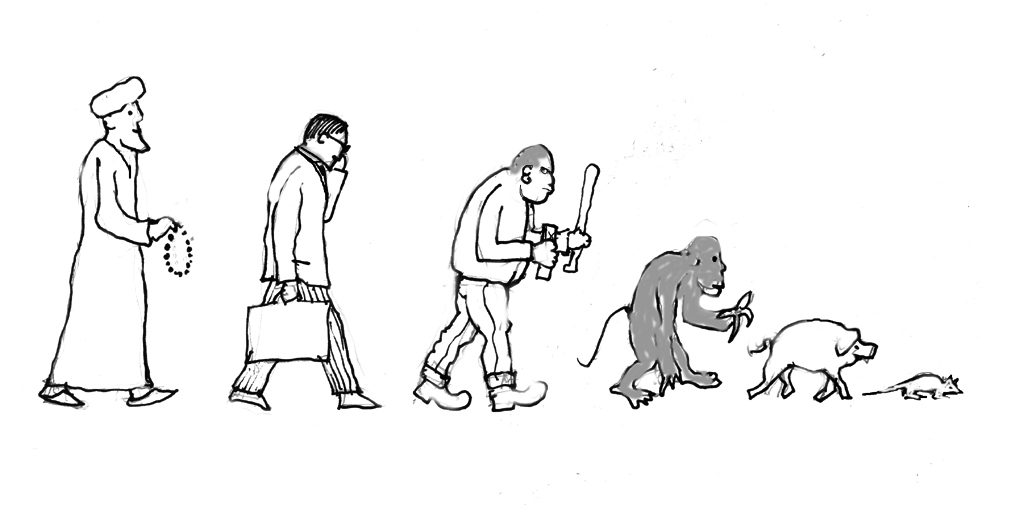
Underpinning this notion that everything is progressing to some future utopia is the Darwinian idea of endless evolution in which might is right and the only deserving beings are the ones who can destroy the competition and survive. The shocking subtitle of Darwin’s famous treatise the Origin of the Species was “or the Preservation of Favoured Races in the Struggle for Life.” Already a kind of racism had crept into the scientists’ theology and maybe how and why Darwin’s ideas were at the root of the Nazis’ Third Reich philosophy and probably all racist doctrines. This idea is symbolised by the drawing – pinned on many a school room wall and which has brainwashed generations – of man evolving from an ape into man. (and then in this example below descending into a manual worker with a road drill and finally a computer operator – quite a telling and pessimistic conclusion really)

Ascent_of_Man_3

Many have written that technology is the next phase of evolution. This is delusionary in my view. I want to suggest a different idea from the ascent of man concept. It’s called the descent of man…here it is below (excuse my drawing which I will improve on dv). This idea is well substantiated in both Quran and Prophetic Traditions and is self-explanatory and makes much more sense to me. Without going too deeply into it here, so-called  progress and technological innovations were merely a crutch which replaced what were God given faculties and skills. I’m not talking of craft tools and so on but things like mechanisation, printing, radio, television, smart phones!….modernity in other words, which Tim Winter describes as “what filled the hole that came with the loss of religion.”The Descent of ManI also want to suggest a much simpler approach to Professor Sheldrake, whose book is as far as I have got, spot on, but which I believe will leave a big question mark by its end. That is, if you begin with a premise that all knowledge is with the Divinity who created it and then work backwards you will arrive at something true. i.e. from revelation. The Dawkins approach is like groveling around in the primeval swamp by comparison and clearly mistaken like an insect trying to weave a beautiful carpet. Don’t doubt this approach before giving it a whirl, but explore where it leads. All your queries will be answered, you will be surprised. What is required is not a Hadron collider to smash matter apart and to find a ‘god particle’ (the word matter comes from the word mother incidentally) but what will smash this illusion of the self, the great idol. With professor Sheldrake’s timely book we can now understand the delusions of science but not yet see our own delusions and the great illusion of perceived metaphorical reality which all of us humans are saddled with. •

Posted in language, miscellaneous, religion, sacred knowledge, science, tassawuf, Uncategorized | 2 Comments