Mending fences, chasing demons.

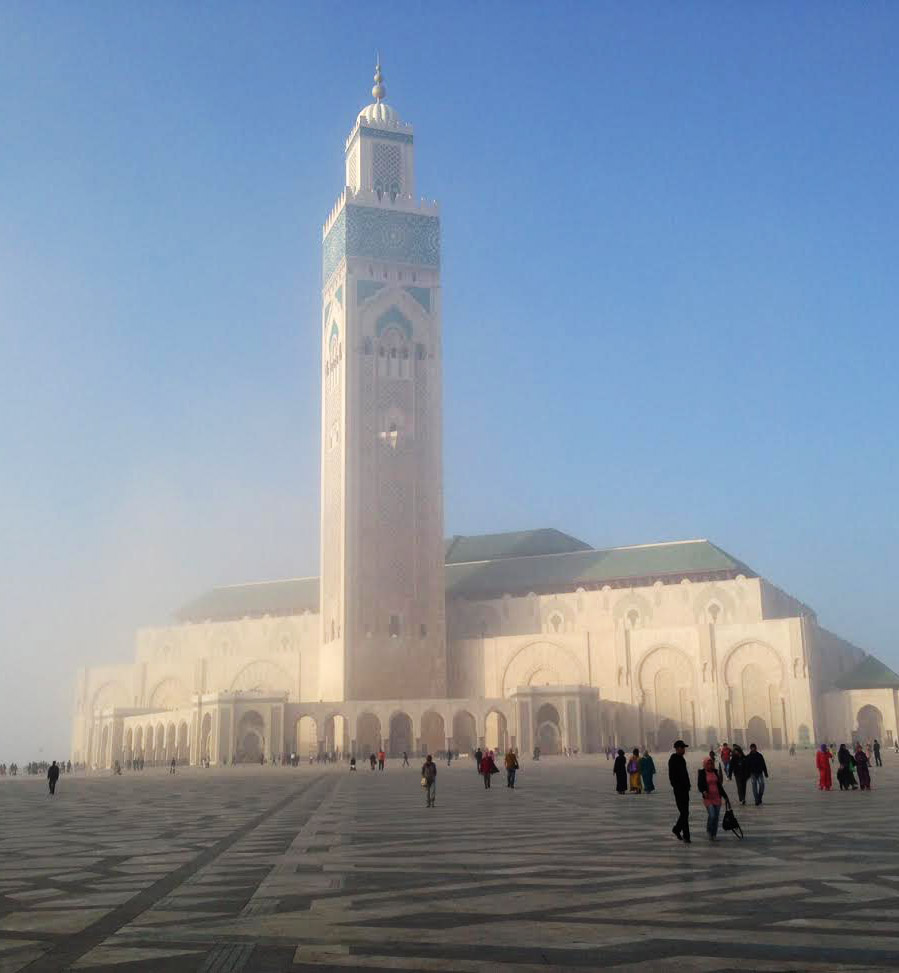
Hassan 11 mosqueI have just returned from a few days filming in Morocco which was an attempt to revisit the time myself and a bunch of young white English and American men and women first visited a venerable Sufi master and his people in the medieval city of Meknes over 42 years ago. I believe the film is an attempt by the producer to find out why and how it all happened and why such people, from often privileged and educated backgrounds, would go against the Christian and patrician grain of English society of the time and embark on what was, ostensibly, such a difficult journey.

The film, which is being shot in several countries, is also trying to trace the history of this nascent community in England, it’s successes and failures and why after ten years it started to fall apart. Any such documentary was likely to look under the scabs of old wounds and to see if there was any way some fences could be mended and some demons expunged. I’m not holding my breath, as rebuilding trust after a divorce is well nigh impossible; but the children of the marriage, the next generation, have a chance if it fully understands what happened and then re-buries the corpse after the post-mortem. Then I think we could all breathe a little bit easier. Some oxygen pumped into this stagnant pond wouldn’t be a bad idea. And I’m saying this to all concerned. Let’s see if the director has the courage not to sterilise the story and cut out the uncomfortable bits of the movie.

I’m tapping this post in Casablanca airport having been snared by failing to check-in at Terminal 1 in time (they closed it an hour before the flight!) and then change to Terminal 2 to catch the plane. Shades of Lauren Bacall and Humphrey Bogart who also had a few problems at this airport. So I had 24 hours to have a quick shufti of this sprawling city, Morocco’s slightly grubby commercial capital.

Initially the traffic in Casa is quite alarming, as cars, pedestrians and carts of vegetables and chickens seem to have independent ideas of who owns the road. But now I believe there is some kind of invisible angelic bubble wrap allowing cars to bounce off each other without actually colliding. Not once did I see a collision, though every minute it seemed inevitable. I also had a quick peep at the enormous Hassan II mosque on the sea shore, enshrouded in a mysterious sea mist, with hundreds of Sunday strollers wandering across its vast concourse. Nice, but a few trees and seats wouldn’t have gone amiss. (see pic above)

My drive to the airport from Meknes was with a fine young Morrocan from the family of the big shaykh we first met all those years ago. He explained in good English how this generation of westerners and Moroccans too, have a confusion with simple word definitions. One of these is the word shaykh which young zealous Muslims get confused about. He said that to a Moroccan,  anyone who is your teacher is your shaykh (often the father of the family) and oddly how certain notable men of high repute in recent times have refused the appellation shaykh even though others would address them as such and wish them to be it. This is why I find it faintly amusing when I get emails addressed to shaykh Ian. I have white hair but shaykh? – I don’t think so. A bloke I will always remain.  Also when a teacher is a master of any discipline he would rightly be called a shaykh as a term of respect. A man or woman might have many shaykhs or teachers. The problems start when a man or woman claims this title as if it bequeaths some divine right of unchallengeable authority, which of course it doesn’t.

We are not a people of claims
The words of an eminent Moroccan scholar.

Morocco remains a place of wonders after all these years and certainly where you learn the true meaning of qabd and bast. (The divine contraction and expansion of the heart).

Last thought: why do travellers in the third world have such enormous suitcases?

Posted in miscellaneous, religion, sacred knowledge, tassawuf, Uncategorized | Leave a comment

Self-publish and be Blessed

sugich

Self-publishing is a topic which flies about the publishing world like helicopters fly around the valley I live in, seemingly never to land. I do see the attraction to a wannabe writer to fork out not very much money and have his or hers masterpiece in his or her hand and it is an idea that is gaining traction. Self-publishing is intrinsically tied up with print on demand or POD as it is acronymed, which enables print runs of one or a thousand as required using laser printing technology. I designed a whole series of books for American poet Daniel Moore between 2005 and 2009, using lulu.com which was a solution to the problem of laying out a lot of cash for a run of books that you had to store and then sell — every publisher’s headache. Furthermore lulu distributed the book and provided the bar codes etc. and got it out on distributor’s lists. Fine so far, but the end result was rather disappointing for me who had been for many years been working with litho printers using beautiful book-wove papers nicely bound with properly sewn sections etc., trying to improve and refine book production. Lulu also limited the self publisher to just a few size formats. It was like eating badly cooked food.

Seeing poetry laser printed on white photocopy quality paper and a cover with automated spine lettering, with cut and glued page sections was a let down indeed. To me printed poetry (and anything else of quality come to that) demands quality typography, quality paper stock, good binding, etc etc., as it is intrinsically part of the magic of the printed word. It proves the author and the publisher believe in their book and want to honour it. It’s as if the smell and touch of the paper are inseparably part of the poem or whatever. It’s all about quality, not quantity and economy. The difference between say an email and a handwritten letter. This is the reason why to me, a poem read on an internet page doesn’t excite in the same way as in the kind of book I describe above. Maybe there is a kind of poem that would suit the internet but I’m not sure what that is. A koan? Maybe a tweet? Poems for limited attention spans. 140 characters.

But things have changed since the early lulu.com experience. I have now sourced quite a few traditional book printers who have now entered the self publishing field and now offer quality books with best papers, binding etc., in all size formats with bar codes and distribution thrown in. You pay more for sewn sections and better paper but not much more and the end result is well worth it. If every author or poet knew how this extra care taken increases the book’s impact, the few extra dollars always looks like a good investment. Not to mention that the book will last a lot longer.

A good American friend of mine, Michael Sugich, has recently dived into this arena having self published his book, Signs on the Horizon, (illustrated above) about his encounters with remarkable Muslim saints over the last 40 years. With my book designers hat on I naturally had serious professional criticisms but strangely the content of the book shone through strongly and its technical and design faults seemed to fade into the background. It was produced using Clearspace.com a Jeff Bezos Amazon company designed to hammer yet another nail in the booksellers’ and publishers’ coffin. Another client of mine in the USA used Clearspace to do a quick pre-print run of a book and I encountered some of Clearspace’s requirements which seemed quite absurd. Eg. requiring a huge inner text margin of 0.75″, a space necessary to avoid the “pinch” when the pages are folded, cut and glued creating a tight book that doesn’t open easily and which is always in danger of bursting when the glue gives out. But it obviously caters for a sector of the market. Although actually ultimately serving Jeff Bezos’s bottom line.

Clearspace looks very much like lulu.com repackaged with the added benefit of Amazon’s goliath like muscle with it’s admittedly efficient book distribution network. I’m told the author gets 35% of the sale which is far more than traditional publishing royalties. So not all bad. But a big publisher has marketing muscle which the self-publisher does not have. This is the argument they use to discourage the self-publisher of course. Self-marketing is the next frontier to free the individual publisher from the old world of publicists and their cosy relationships with broadcasters, news media, advertisers and so on. But what shape that will take I am still waiting on. The internet has changed everything.

By the same token I am disappointed with ebooks which return books to a kind of anarchy where you choose the font, the size etc which although has its uses goes just a step too far. Curiously I read the other day that a man who suffered from dyslexia all his life found that by ranging all the text left in an ebook he could read easily as all the inter word spaces were equal. This may not be the cause of all dyslexia but it’s worth noting. Also for those with difficulty reading like children or old people being able to enlarge the text you can see the advantage.

But I return to my protestations about dumbing down the book because the origins of knowledge are intertwined with the idea of writing, pages and books. These are the metaphors used in revelation and why we have to honour more than we do the almost sacred nature of how we convey and preserve words and language on paper (or by electronic means come to that).

In my job I’m always looking for the perfect book with a perfect marriage of content, design and printing, with paper that will last for hundreds of years (sewn sections, acid free book wove, high rag content etc). Because when the hard drives and the sold state memory banks of the world of stored knowledge and information give out there will be something of quality left to read. Who knows, vellum might make a come back one day as it outlast everything short of carving into granite.

PS There are very good alternatives to Amazon who I have got tired of and who at the time of writing are about to be exposed by a BBC Panorama programme as running what looks like exploitative and inhuman working conditions for their workers. I just used Books etc., which went well. They also enable you to sell your own books at a cut of 15% to them. When I was last selling books though Amazon they were taking 60%!  The public’s hatred of Ryanair, the Irish cheapo airline, has been so intense of late that they have en masse gone elsewhere and directly contributed to a second profits warning for Ryanair this year. Now for Amazon. It’s time we realised that the Amazon maybe the biggest river in the world but is full of piranhas.

Posted in typography / design | 3 Comments

From Mods to Mecca

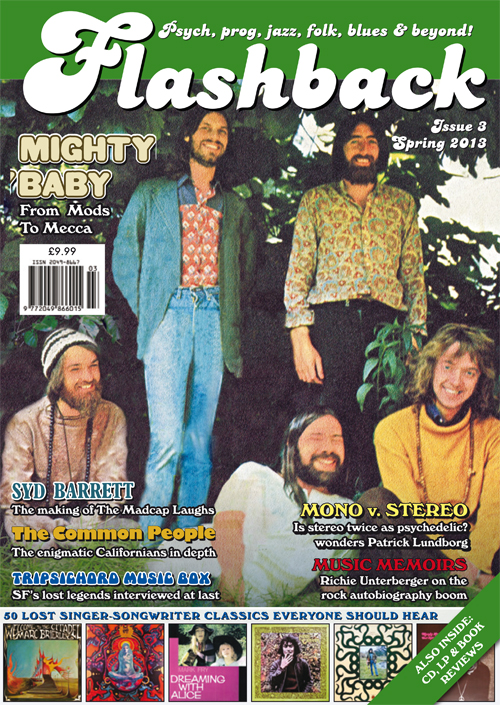
Nostalgia has always been big business. Look how the Victorians ached for a romantic gothic past and the Edwardians for a rapidly disappearing bucolic world with the arts and crafts revival. To find my own past the subject of a nostalgic movement was for me a bit of a curiosity as earlier this year saw the release of Flashback (3rd edition), a magazine for folks for whom late 1960s prog rock was a great forgotten period of British music.

Flashback_Issue 3_Spring 2013

Its featured article was entitled, eye-catchingly, from Mods to Mecca. This arcane genre of music is not necessarily the realm of bald headed,  grey haired freaks, but apparently  people of all ages (mostly blokes I imagine). Richard Morton Jack, an Old Etonian who is in his early 30s, publishes the magazine dedicated to this prog rock period from about 1967-73 and wrote From Mods to Mecca a 39 page feature about my erstwhile friends and co-musicians of the rock group Mighty Baby which was born in 1967 out of the ashes of the great London 60s mod band The Action. Mighty Baby floundered in 1971 for many reasons which the article describes in detail.

Aside from whether you like the music, (you don’t have to) it’s an unusual story of how a group of musicians of mixed English backgrounds (middle and working class) met up in 1967 and after a jolly few years playing music just about everywhere and with everyone, ended up with firstly a real Sufi brotherhood in North Africa, meeting one of the truly great muslim saints of the 20th century, and subsequently going on the pilgrimage to Mekka. (Well three fifths made that journey.) The article, richly illustrated with photos and newspaper cuttings, is 99% accurate, historically speaking, unlike previous histories which were pretty fictitious and incomplete. Richard Morton Jack dug up things I had completely forgotten about and found photos I had never seen before. The band’s music was also featured in May this year on Stuart Macone’s BBC radio 6 show called appropriately The Freakier Zone.

To the establishment you can’t mention things like Glastonbury or names like Jimi Hendrix or George Martin in the same breath (or article in this case) as Islam and the Haj or Sufi shaykhs. Almost like oil and water. But Richard Morton Jack courageously tells the whole story and leaves the reader to judge for himself. I say the establishment, because when Cat Stevens was embraced by Islam (it’s interesting to phrase it that way round), the UK establishment did their best to slaughter him. Though well intended, Yusuf put his head too far above the parapet and just didn’t have enough media savvy to deal with it, but also Islam, the religion. was something not wanted in the public discourse as something rational and an option to be considered by ordinary people. So at every opportunity journalists (the voices of the ruling establishment) set out to trap him and resurrect all the old canards about oppression of women, the Satanic Verses issue, jihad and so on. I was personally present at a live BBC radio interview with Nicky Campbell, about Yusuf’s Bosnia War CD when his opening question to Yusuf was “how can you follow a religion that condones the rape of women?”  This gives you an idea of the deep seated hatred and ignorance of anything to do with Islam that is dormant in the British psyche and which I believe goes back to colonialist times when the British were heavily brainwashed against the Turks, Arabs. Africans et alia, just about everyone the British were colonising and whose lands they were plundering in the name of Christianity and progress. That’s another story but is the background to the Mods to Mecca narrative.

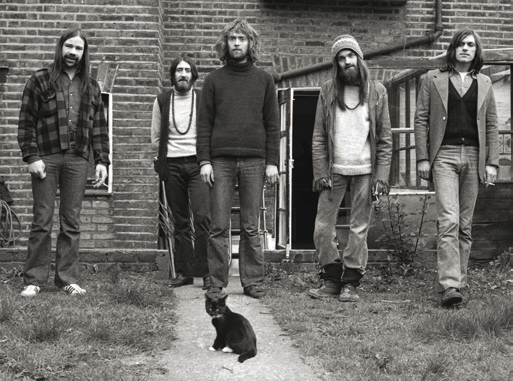
mb monmouth rd

Photo by the late Keith Morris 1971.  

To me it still seems impossible now, in fact almost miraculous, that this was to be our destiny – from just itinerant rock musicians to hajj pilgrims. The Flashback article reveals the complete story, which for me is both gratifying, shocking, sad and bizarre all at the same time. It’s from so long ago that it seems almost to be about someone else, not me. But in case anyone thinks it just happened out of the blue, let me put you straight. In fact the direction the music was taking, the chemistry of the band, the books studied on gigs and so on, all led to this amazing conclusion. Both a logical and a theological outcome. The music was the means to the end and let no-one tell you otherwise. Some say we arrived at the gates of a Islam in spite of the music. I beg to disagree. It not only took us to the gates, but through them and on right up to this day. I am the same person now as I was then with just less negative baggage and with accrued wisdom from the journey. Music is very powerful and a hot divisive topic amongst muslims but my experience convinced me that with a good heart, music can serve you and give an uplift and ease to the heart like nothing else. Of course it has a satanic side, what in the realm of human activity doesn’t, but to disparage music purely for doctrinal reasons is senseless. It’s another subject but not to be explored here.

For many years we were all frankly embarrassed by the whole thing and nobody wanted to talk about it. I think this was partly because of the horrendous collapse of our Sufi community in 1983 and the considerable antipathy toward its leader whose shenanigans had destabilised too many lives and families in the 1970s and a drama around which there was a kind of omerta, a traumatised silence. We didn’t want people to know what had been going on out of a sort of twisted shame. But this silence was also because the music Mighty Baby had been playing was nothing to do with commercial rock music but more of a mystical adventure set to music and words, which we knew few would understand. And it all got mixed up with what came later and all the Sufi capers. It had been a journey into the spiritual unknown for all to see. The story is spelled out in the song lyrics of the final album Jug of Love, and particularly in the lyrics of Martin Stone, the wizard front-of-stage guitarist. This final swan song of an LP told the story of the spiritual awakening of this pretty unknown group of musicians and what they were experiencing right at the time the record was being made. When it was released the record companies and music press unsurprisingly missed all these subtleties, but a recent review of the band’s last album that appeared in Rolling Stone magazine, when it was re-released on CD (and vinyl),  expressed it succinctly.

“Mighty Baby were original acid-country mystics: remnants of a great British mod band, the Action, that went psychedelic in the late Sixties, then turned down the amps and amped up the prayer. By the time of Mighty Baby’s second album, A Jug of Love, issued in Britain by Blue Horizon in 1971, most of the band members had converted to Sufism, the mystic Muslim sect, and the record is aptly meditative: slow, extended songs of self-examination sparkling with fireside harmonizing and the gently serpentine lead guitar of Martin Stone. Although Mighty Baby, as practicing Muslims, subscribed to a natural high, the record’s vibe is more stoned than sanctimonious, a trancelike blend of the Middle-era Floyd, the Byrds circa Ballad of Easy Rider and how, I suspect, the Grateful Dead sounded in early rehearsals for American Beauty. A Jug of Love, a big-money rarity for years, has finally been issued on CD by the Sunbeam label. It still overflows with sweet OM.” (David Fricke)

So in the last ten years I have grown to accept that period of my life, who I was, profane language and all. As far as nostalgia goes, I am not nostalgic for that time as it was hazardous and chaotic as well as exciting– creative and destructive simultaneously. Many of the people I knew and worked with from that time are now dead. They died from lifestyle poisoning. So don’t get too dewy eyed for this lost epoch. But reading about it might just open someone’s heart and mind all these years later and how remarkable things come out of the most unlikely situations. It did happen and it’s all true although the Flashback story is only part of the whole picture which will be told some day I hope.

If you are curious to read more about all this caper you can either buy the 208 page magazine or download a pdf from www.flashbackmag.com. Several Mighty Baby albums are now available from Sunbeam Records in London and can also be downloaded from Itunes.

Posted in music, Publishing, religion, sacred knowledge, tassawuf, Uncategorized | 6 Comments

The Descent of Man

l'oreal

The latest L’Oreal TV ad goes like this: A beautiful female model pouts, “I believe in science, I don’t believe in miracles.” It’s a statement of faith. Odd, as they have a product called Revitalift Miracle Blur. So I don’t think L’Oreal know quite what they think.

When you look at the wonder of the seamless universe of vast infinite space and the enormous galaxies and suns around which planets orbit effortlessly and on whose surface vast lands, mountains and oceans contain unending varieties of teeming vegetable, animal and aquatic  life concealing subatomic worlds mirroring the outer worlds in which tender mercy is manifest every moment every time new life is born and nourished and in which men and women of knowledge and intellect contemplate and worship, openly and in secret, the incomprehensible power of its creator and sustainer…don’t you just groan when scientists reduce it all to a two dimensional TV programme with the inevitable catechism…”but science tells us…”…!! Thank you Professor Brian Cox.

One scholar rightly describes this as the tyranny of modern empirical science in which the wonders of life and the universe, of cosmology, mathematics, astronomy, biology, zoology, physics and chemistry and so on, are reduced to a random accident in some kind of primordial deadly molecular olympic games of survival of the species. Where is the awe? Where is the wonder? Where is the humility? Where is the truth?

CERN, the 28km diameter hadron collider is the way that the modern scientific mind approaches the mysteries of the universe. Smash it to pieces and see what it tells us and squander a vast fortune in the process. Almost a metaphor of how modern man deals with the feared unknown –i.e. blow it to pieces. Rather like the Manhattan project when an atomic bomb was first exploded at Los Alamos in New Mexico in 1943, they didn’t really know what would happen but they just had to do it. I’m not diminishing what the incisive scientific mind can discover and intellectual brilliance when it produces some good, but sorry, it is not the same as the great spiritual adepts of history, who tasted and experienced realities and knowledges that the scientists of this time couldn’t begin to imagine. Nor did their knowledge unleash destructive technologies on the scale of the industrial world that we all know. Anything not visible or ascertained by scientific method is written off as hokum and non-existent….which is hardly scientific if you think about it. Which allows them to posit anything they feel like. But then science has raised itself to quasi-religious status nowadays which no-one is allowed to challenge, which I don’t think was the intention of the enquiring minds of the renaissance. Scientists, from their scientific institutions, with their pulpit of BBC science programmes, hand down their interpretation of reality to the masses as religious doctrine — and often aired on Sundays appropriately. Anything of a religious nature is presented as a superstitious fiction if mentioned at all.

I am currently reading Rupert Sheldrake’s excellent book, The Science Delusion, which puts some some flesh on these ideas and supplies the history of how science made itself into a religion. It’s a factual and rational explanation of how materialism has come about and how people like the atheist evangelist high priest Prof. Richard Dawkins have reduced existence to its lowest common denominator…molecules. The trope Sheldrake uses to debunk Dawkins is of someone grinding a computer down to dust and then trying to discover what that sophisticated machine was in the first place by analysing the raw materials. I’m only a little way into the book and it looks promising, though Sheldrake is a microbiologist himself and sees things from a trained scientist viewpoint. To him, there just seems too much that modern science cannot explain. Too much of how but not enough why. Since the time of Sir Francis Bacon in the 17th century the science establishment has seen itself as an augury of a future world in which scientists controlled, understood and guided everything in the world like high priests and it’s pretty much what has happened.

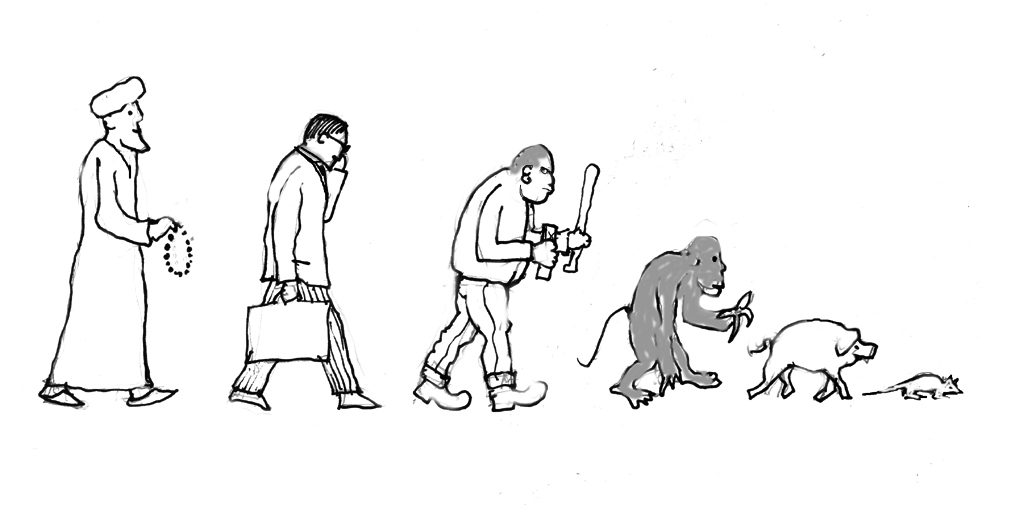
Underpinning this notion that everything is progressing to some future utopia is the Darwinian idea of endless evolution in which might is right and the only deserving beings are the ones who can destroy the competition and survive. The shocking subtitle of Darwin’s famous treatise the Origin of the Species was “or the Preservation of Favoured Races in the Struggle for Life.” Already a kind of racism had crept into the scientists’ theology and maybe how and why Darwin’s ideas were at the root of the Nazis’ Third Reich philosophy and probably all racist doctrines. This idea is symbolised by the drawing – pinned on many a school room wall and which has brainwashed generations – of man evolving from an ape into man. (and then in this example below descending into a manual worker with a road drill and finally a computer operator – quite a telling and pessimistic conclusion really)

Ascent_of_Man_3

Many have written that technology is the next phase of evolution. This is delusionary in my view. I want to suggest a different idea from the ascent of man concept. It’s called the descent of man…here it is below (excuse my drawing which I will improve on dv). This idea is well substantiated in both Quran and Prophetic Traditions and is self-explanatory and makes much more sense to me. Without going too deeply into it here, so-called  progress and technological innovations were merely a crutch which replaced what were God given faculties and skills. I’m not talking of craft tools and so on but things like mechanisation, printing, radio, television, smart phones!….modernity in other words, which Tim Winter describes as “what filled the hole that came with the loss of religion.”The Descent of ManI also want to suggest a much simpler approach to Professor Sheldrake, whose book is as far as I have got, spot on, but which I believe will leave a big question mark by its end. That is, if you begin with a premise that all knowledge is with the Divinity who created it and then work backwards you will arrive at something true. i.e. from revelation. The Dawkins approach is like groveling around in the primeval swamp by comparison and clearly mistaken like an insect trying to weave a beautiful carpet. Don’t doubt this approach before giving it a whirl, but explore where it leads. All your queries will be answered, you will be surprised. What is required is not a Hadron collider to smash matter apart and to find a ‘god particle’ (the word matter comes from the word mother incidentally) but what will smash this illusion of the self, the great idol. With professor Sheldrake’s timely book we can now understand the delusions of science but not yet see our own delusions and the great illusion of perceived metaphorical reality which all of us humans are saddled with. •

Posted in language, miscellaneous, religion, sacred knowledge, science, tassawuf, Uncategorized | 2 Comments

Rumi, Rihlas and Other Considerations


KONYA••

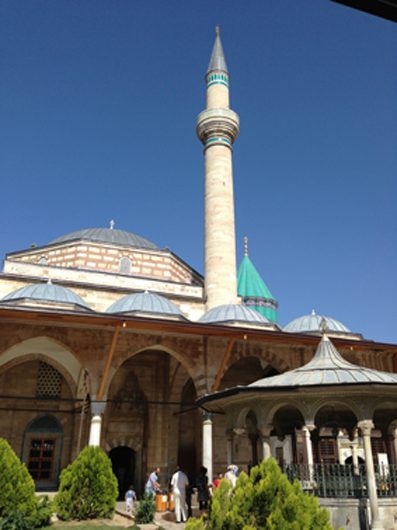
If you are Turkish, Afghan or Iranian, most likely you would consider your ‘bard’ to be Jalaluddin Muhammad Rumi the great poet and Imam who is buried in Konya, the capital of central Anatolia, Turkey. He was born in Balkh, Afghanistan but after migrating to Turkey where he settled and taught he wrote his twenty seven thousand couplet poetic masterpiece, the Mathnawi which was written in Persian. He died in 1273 CE and is buried in Konya in the most beautiful of maqams (pictured above)  In recent times translations of this work have been made into every language of the world and which has seen Rumi become, in the case of North America, its best selling poet. (a manuscript from 1479 in Persian pictured below)
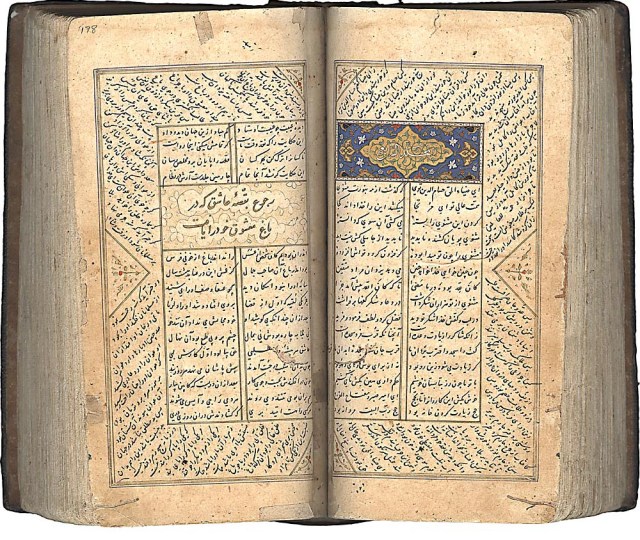
rumi mathnawi

So, when given the opportunity to attend the well known Deen Intensive Rihla in Konya this past July, my wife and I jumped at the opportunity as there had to be something special waiting for us there. To most people who read this blog the words Rihla and Deen Intensive are probably well known but for those who just happen to have dropped in and don’t know, let me give you a brief explanation.

The Rihla was conceived back in 1995 in the USA by the well known teacher and translator, Hamza Yusuf (amongst others) as an opportunity for anyone who wanted to study, intensively in a residential situation, a selection of the traditional Islamic sciences with prominent scholars, over a three to four week period in the summer break and in an interesting venue. The scholars would teach in English and could give the students the best of their knowledge over a short time which would traditionally have entailed the student traveling over many years to different countries and gathering such knowledge, having first mastered Arabic of course, and enduring all the rigours that this would have demanded.

So it was designed for those whom a life devoted to scholarship would be impossible, but who were able shell out a fairly hefty sum to attend for this brief period. It has over these last 18 years proved a remarkable success and continues to attract 150-200 students of all ages every year from all over the world. The subjects covered every year would find their place in the curriculum of any self respecting seminary or university in the muslim universe and include Aqida, Qalam, Logic, Fiqh, Sira, Tajweed, Tasawwuf etc., * (see below for translation) and much more, but all embraced by the broad and luminous shariah. Shariah being a very much abused and misunderstood term in the Western universe who have confined it to amputations and similar cherry picked distortions. Appropriately its accurate translation is “the wide road that leads to an everlasting spring of water”, a special meaning for a desert dweller and also for the dweller in the modern desert of the western world desperate for the essential water of divine knowledge.

In the 1970s we used to go yearly to Morocco to attend great moussems and mawlids of singing, hadras and visiting living and dead saints and benefitting greatly but with little or no real study of what it all meant and why. Not that we could have sustained such study at the time. I have seen a common phenomenon in nascent muslim cultures in the west over the last 40 years or so of the tariqas or sufi brotherhoods and how they became the necessary starting points in countries where no Islam existed which was the case in point in London in 1970 when I opted in to this particular religion. It was like survival Islam and the brotherhoods (which was also a sisterhood in fact) helped concentrate study, practice and create a kind of social nexus in a town or city location (in London in my case). And for a few years we became Moroccans both in dress, culture and religious practice.  But despite its outreach it remained quite insular and eventually fell foul of the usual problems of such communities: group think, mismanagement, economic collapse and after an exodus to Norfolk, complete disintegration into rancorous civil war.

I mention this because looking back I think it was a lack of a certain fundamental education that left no real foundation for any future growth although it sufficed for a time. Tasawwuf (sufism) was always one of the traditional sciences embedded in the shariah studied in Muslim seminaries going back over a thousand years to the time of Junayd who consolidated this knowledge and who is considered the Imam of this science. But our early education subsumed all other sciences under the rubric ‘tasawwuf‘ which is clearly incorrect. We were to be sufis more than anything else. The term tasawwuf has many translations but rectification and purification of the heart is the most useful. But it is only part of a spectrum of essential knowledge for the traveller on a spiritual journey. It deals with unravelling and cleansing the human heart of all its vices like envy, lying, idolatry, backbiting, arrogance and so on and in these times probably the most important initial medicine for people who enter Islam from the dominant culture.

But even a few hundred years ago the value of tariqas was called into question by such scholars and authentic teachers as Sidi Ahmad Zarruq who had in his lifetime seen tariqas become corrupted in different ways. In the late 1970s and early 1980s we saw the same thing happening in the UK. What was needed was a new sound basis for all of the Islamic sciences in which tasawwuf could take its proper place so that sincere seekers could be protected from charlatans and the latent cultishness and corruption of ‘groups’ of this kind – but still benefit from its core function.

Since the 1980s quite a few young men and women from the west have ventured into the traditional muslim world and have returned with authorised knowledges which they have set about teaching. This is where we come back to the notion of the Rihla which means essentially “traveling for divine knowledge”. This is where the overview of knowledge so much needed can be established in a kind of roving university that the Rihla is. In the past it has tempted gifted students to take this kind of study much further and who have become qualified teachers themselves.

Much as I know that tariqas have fulfilled a vital service in conserving this teaching down the centuries, something I have benefitted from personally, I can see how some have become unfit for purpose and have trapped their devotees in cults which deny them the bigger picture in which both men and women can advance in the acquisition of sacred knowledge and spiritual growth. In traditional societies there were many scholars, muftis, qadis and faqihs in circulation to keep the balance and to counsel sufi shaykhs if they got out of line…and in fact to counsel anyone from kings to the common man — something lacking in western cultures till recently. Remember that the great lights of muslim history, Imams Al-Ghazali and Jalaluddin Rumi and in my own time the great Moroccan teacher and poet Muhammad ibn Al- Habib who passed away in 1971 at a great age (shortly after we met him), were first and foremost great ulema, masters and teachers of outward formal knowledge. It’s worth reflecting that Ibn al-Habib was teaching these sciences in the Karoueen Mosque in Fes in 1900!

So this Rihla in Konya for us was very beneficial, albeit for a week, and was as illuminating as weeks of singing and dancing in Morocco 40 years ago. It was filling all the big gaps that my initial introduction to Islam and Sufism had left me with. The content of Rihlas from this year and last year can be viewed online at DeenIntensive.com so you can ascertain yourself what it was all about. Viewing on-line is not the same as being physically present but nonetheless is very beneficial. Its strong web presence is a symbol of its relevance in the digital universe but with its feet firmly in the ground of person to person teaching. Receiving knowledge from teachers authorised to teach from an isnad of authorised teachers is very different from instruction from auto-didacts who have constructed what they teach from books and knowledge gleaned from unauthorised sources and who make false claims as to their authority. What is most refreshing at these Rihlas is being in the company of people who sought no identity or distinction in the group, in their name, their clothes or what sat on their heads other than being muslims and sincere seekers of knowledge. And how after only a week you can closely bond with people you have never met before and how your whole interior perspective can be changed and refreshed. It really puts the holy back into holiday.

 “Travel, that ye may gain advantage” (Rumi) 

* Approximate translations of the terms above of a sample of Sharia sciences:
Aqida: belief; what we can believe and cannot believe about God. (Imams ‘Ashari and Maturidi)
Qalam: literally speech; theology, deeper knowledge of Aqida
Fiqh: jurisprudence / sacred law. (Imams Malik, Shafi’i, Hanafi & ibn Hanbal)
Tasawwuf: sufism; spiritual purification and illumination of the heart. (Imam Junaid)
Mantiq: logic
Sira: life of the Prophet
Tajweed: correct Qur’anic recitation and pronounciation

Posted in language, miscellaneous, religion, sacred knowledge, tassawuf, Uncategorized | 3 Comments

Translation, Lost and Found

SHAMAI'ILMay28temp arabic.indd

Above: A page from an as yet unpublished edition of the Shama’il of Tirmidhi.

Part One
Although my work is principally typesetting books, something previously done by men in inky overalls composing metal type, I do actually read some of them and it might explain why when I write on this blog about what I hope might be of some practical typographical value I cannot but help slip into philosophy, religion and metaphysics and all that comes with it, as many of those books I have worked on are often translations of important and famous texts on these subjects – mostly from Arabic with the Arabic and English running in parallel. And quite an education it has been. Studying the texts has really rammed home to me the crushing responsibility of the translator’s job. Not only must he or her deeply understand the foreign language concerned and the subject matter, but also have a profound grasp of English and all its subtle nuances and get it right. Their word choice can have life-changing impact and lead people in all kinds of right or wrong directions. Especially such texts as the source books of Islam like the Qur’an itself and the many collections of Prophetic traditions that surround it. Which is why commentaries and explanatory footnotes are so important to flesh out the translation.

In the last 40 years there has been a huge unstoppable convergence of different cultures all over the world especially in Britain and it has been very visible for me in setting these translations mentioned above, as two languages on the same page, one in roman text ranging right to left and the other in arabic script from left to right makes particular demands. In the same way the translator has had to refine his words to excellently express meanings, the task of a designer is to reflect that as clearly and as beautifully as possible with type. It is a wonderful metaphor for how cultures should merge. When the cultures clash it is often because they haven’t been juxtaposed in a beautiful way and the scripts coming from opposite directions collide rather than blend harmoniously. There is a parallel in human behaviour and how good manners can facilitate so much in life, the elixir for just about everything in fact. Is there not good manners in the way a page of text is designed? The designer of course needs to know deeply the roots of western design and calligraphy as much as that of Arabic or Persian if he is going to succeed. The exact parallel of the translator in his or her work. And in a different realm the same could be said of the way a mosque might integrate into an English urban landscape.

Recently I was a consultant on the Cambridge mosque competition for an English architect who asked me some quite reasonable questions, one which was how to reconcile a mosque facing Mecca with a road frontage which is not, and more generally how do you design a mosque that integrates harmoniously into say a northern English town. Safe to say that too often mosques are like a two finger salute to the local vernacular and built environment with the oh-so-predictable dome and minaret. Now to me this is the height of bad manners. But it is an an honest metaphor for what is going on socially and politically.

The new Cambridge mosque project has, to its credit, taken a much more considered route with a lot of local consultation and an interesting mosque design concept by architect David Marks of Marks Barfield who were responsible for the London Eye opposite the Houses of Parliament. Now when I first heard they had won the competition I had visions of a funfair mosque with a helter skelter minaret down which the muezzin helter-skeltered after calling the prayer. But after going through various evolutions the final design has matured and I actually quite like it now, as it has done its utmost to blend in with the surrounding landscape and is a serious attempt to blend various traditional motifs with what is in fact a hi-tech eco-building. Quite a leap from the brief I was given some years ago for a sketch design for this mosque which requested an Anglo Ottoman style of architecture. (I might reexamine this idea in a future post).

Because the proposed mosque has full approval from Cambridge City Council and is of a high architectural quality the locals generally accept it. It is thought it might even raise surrounding property values. It doesn’t have a minaret and the small token green dome will be barely visible from the road I think. Some might say it doesn’t look a mosque. Which in many ways is in its favour I believe. It is doing its best to dodge the cliche and all the baggage that goes with that cliche. Personally I think the dome could have been dispensed with but I presume some people like the link with tradition even though the idea of a dome for a large space predates Islam by thousands of years. I suppose its symbolism prevents it been mistaken for an upmarket industrial shed or a telephone exchange.

The architect I was consultant to in the mosque competition asked me where in the Qur’an the rules were for building a mosque. The answer of course is nowhere. The first mosque was just an open area defined by a low wall and what became a famous palm tree. In other words anywhere within reason (like not in a road) if it is clean and where you could put your head on the ground. How it was organised was entirely up to those concerned in building it. There were times in history when Muslims and Christians shared the same prayer space as in Cordoba and earlier in Jerusalem – a pragmatic solution with no fuss about the style of architecture. But on the whole if you ask most muslims what a mosque space should be you would get a very wide range of answers. Most actually don’t know or are confused or regrettably the dome and minaret idea.

It all comes down to translation and the challenge of bringing something of a seemingly alien nature: beliefs, ideas, culture, the printed word or buildings into a new environment. Much has been lost in translation to date but in time things will improve as it all takes on new hybrid forms.

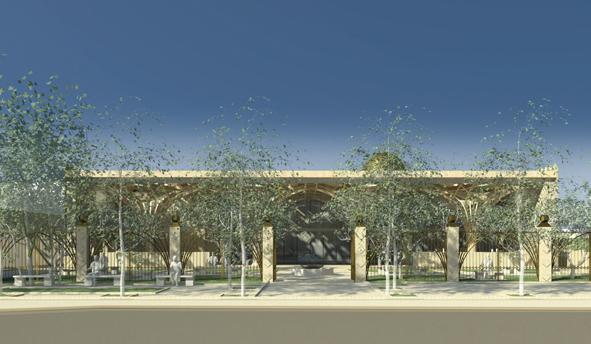
cammosque

The Mill Road aspect of the proposed new Cambridge mosque.

Part Two
The subject of mosque design has occupied me a lot in the last thirty years, and at one point a couple of years back I was invited to speak at a small symposium put on by the Arts Council (and others) in London on this very subject: Spiritual Spaces in an Urban Environment. Up to that point I had considered that a mosque space needed to be traditional because the religion itself was based on tradition and anyway I could not abide all the nouveau trends in mosque architecture which exploited every kind of fashionable technology. I didn’t understand Zaha Hadid type buildings and neither did the audience at the symposium we were participating in. Necessity created the minaret as a means of the call to prayer reaching people from a high point and domes or columnated spaces were arrived at as a way of creating large spaces and were not created out of some religious dogma. However to depart too much from such conventions in the modern context causes consternation and not without cause. After all the human form is a traditional thing, on the form of the first man, It is what gives things meaning. We are looking back down the long corridor of time and it is possible to draw on all that experience.

Modernity has, however thrown a spanner in the works as suddenly creating interior space was not restricted by what could be built by hand and human scale was the first casualty. Technology given birth by the industrial revolution, disconnected architecture from craft and allowed builders, architects and engineers to run riot and create new ways of construction. Tradition was still a powerful influence though and the Victorians created some remarkable structures with strong historical references in wrought iron and glass covering previously unattainable expanses of interior space: the great glasshouses at Kew, the famous dome in Buxton covered in slate which is bigger than St Peters Rome, and many of Britain’s great railway stations.

The amassing of capital and the profit motive was instrumental in the industrialisation of building and remains as the motivator of modernity and what leaves us with all this debate about just what is a spiritual space. Much as I love the beautiful traditional mosques that you will find from Beijing to Fez, attempting such ideas in a western urban environment is extremely difficult. The Paris mosque is maybe the one exception that worked as it conveniently fits a whole block and is more a collection of interior spaces than a building very much as it would integrate into a traditional north African city. And it was utterly north African, built by craftsmen from Morocco and was a model of local cooperation with the opening prayer conducted by Shaykh al-Alawi of Mustaghanem and the then French premier. The Woking mosque worked well being the first in the UK but it was standing on its own in a small park. In general the cliché of minaret and dome mosque that has sprouted up all over the UK and Europe reflects how awkwardly the new communities have attempted to blend into their host communities. To me it’s “in your face” architecture and in many ways understandably provokes the local community. I realise that many people came into the UK who weren’t educated in the fineries of architecture or town planning but even where immigrants were educated as in the USA the results were the same, an awkward blend.

Of late I have been thinking that one possible urban solution is to create a space for retreat off the street for anyone who is in need of spiritual solace, or just to rest your feet without having to pay for a coffee. It can be like the prayer spaces that have cropped up in airports, football stadiums and even office blocks and factories. When walking through central London recently I was intensely aware of a need of something to counter the horrific commercial pressure everywhere. Non-denominational prayer spaces seemed like an obvious answer paid for by banks. Maybe if people learned the basic good manners of sharing a prayer space they might learn the manners of building a mosque (or a temple, synagogue or whatever) in an unwelcoming environment.

In a remote country situation the hitech modern solution seems inappropriate and a design driven by indigenous building techniques is best and probably cheapest and then you are fairly safe. My own choice is to avoid prestressed concrete, steel and ‘hard’ cement products produced by high firing techniques. A building constructed from say adobe bricks with a wooden or vaulted roof has an unrivalled stillness and beauty that is effortlessly a spiritual space. The actual design, proportions and details can also reflect calm and stillness but these are more conditioned by cultural and artistic factors. The community who will use it can, if at all possible, also help in the construction which helps bind them to it for ever. But importing all that into an urban context is well nigh impossible. Health and Safety stop it dead. And even in a remote situation there will still be legal and cultural hurdles to cross. All the courtesies required in the Cambridge case still apply, but it is just less complex.

Ultimately, any building is like a glove on a hand and is no better or worse than the vision, aspiration and abilities of the community of men and women who build it which is why architecture can tell you so much about history and about our forbears and what they were up to. Architects should of course be the servants of their clients but the intention behind such things as mosques is what produces the final result and when you walk into such a mosque for the first time you meet that intention full on.

Posted in architectural, language, miscellaneous, Publishing, religion, typography / design | 1 Comment

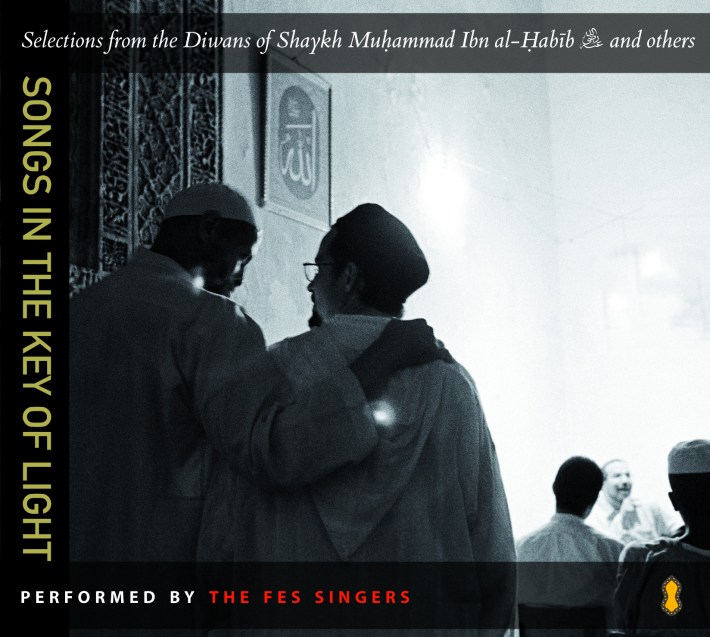
Songs in the Key of Light

Image

This much anticipated CD arrived on my desk last week. I had sent off the artwork to the USA a few months ago and I was glad to see it at long last. The cover picture aroused my curiosity but I have now figured out that the photo of Hamza Yusuf and Zaid Shakir walking into a room in which Muhammad Bennis is apparently singing (Muhammad Bennis directs the Fes singers on this CD collection) is a way of introducing to a new kind of audience this kind of singing.  It is also, I think, intended to introduce it to the Diwan of Muhammad Ibn al Habib, the renowned saint and teacher, who is buried in his zawiyya in Meknes, Morocco, which is pictured on the inside fold of this digipack. Several of his qasidas (poems) are excerpted here on this CD as well as some other famous Moroccan qasidas. Twelve years ago when I first met them, the Fes singers did not know this Diwan and it is interesting for me to hear them lending their talents to singing it as they bring some refreshing new naghmas (tunes) to it. Muhammad Bennis is a fathomless well of these ancient naghmas which all his life he has collected and taught to many others. He also has a gift for arranging them in appropriate sequences which is a science in itself.

Some of the tracks on this album were recorded in 2009 in a recording studio in Toronto but ever since we recorded the Burda in a studio in Fes in 2001 I have been a bit wary of recording studios which in my opinion don’t really lend themselves to this kind of singing as it tends to suck out some of the atmosphere necessary for Andalusian singing to work. I prefer a live acoustic recording as long as a PA system is not employed. To me the ambient noises don’t matter too much, but the spirit of the event does. Nonetheless the Fes singers have still put in a good performance here despite this disadvantage. This CD introduced me to some new unusual naghmas for some qasidas that I know only too well so I have gladly added them to my own armoury of melodies.

With one track on Songs in the Key of Light featuring the imarah or hadra, some eyebrows will doubtless be raised but Sh. Hamza’s liner notes necessarily makes mention of it and explains its purpose. Hadra is a controversial subject but having been familiar with it myself for over 40 years I do think that it is misunderstood and I include in that some of the people who practice it. Muhammad Bennis has told me on several occasions that the hadra is the singing and without the singing it is greatly limited and becomes just a dance. Traditionally there is a gradual sung build-up to the hadra and this can be likened to building a fire. Some qur’an and spiritual discourse always traditionally followed it.

Certainly the singing that accompanies a hadra can make or break it as the human voice is capable of making the heart soar or just distracting it. I am less impressed when hadras degenerate into a kind of folkloric ritual or showing off. It is a science which needs to be taught properly otherwise it becomes something rightly criticised. Whether it is technically some kind of innovation is not within my remit but I do know that many great scholars , shaykhs and ulema, particularly from North Africa, have endorsed it.

There are no plans to release Songs in the Key of Light outside the USA though it can be purchased direct from http://www.sandala.org or downloaded from Itunes.

Posted in typography / design | 3 Comments

Mapping the Universe

Man uni on whiteFlipping through my WordPress account recently I realised how many unpublished draft posts I had written which I had just parked out of sight. Some were on medical subjects, others on eschatology but mostly on subjects in which I was clearly out of my depth. But also on subjects which by their very nature are radically out of line with the status quo of the 21st century world. And here’s one of them for your delectation as I thought, well what have I to lose? Not my usual fare but the kind of thing I often reflect on privately. If I had read these ideas elsewhere I would have no need to write them, but I don’t, which is why I’m publishing these following brief observations on one aspect of modern science.

A group of American astronomers have for the last six years been trying to map the universe. Yes that’s right, map the universe. A rather enormous task by any standards and no surprises when their conclusion was that the universe is in fact infinite and difficult to map as only one sixth of what is out there is actually visible and that it is expanding at a rate of knots.

Historically cartography was intertwined with the colonial impulse, the greed based quest for Eldorado, ‘the Gold’ and it seems, not unreasonably, to suspect that these astronomers aren’t solely motivated by the spirit of pure scientific enquiry. The BBC Horizon programme on this mapping project, aired recently, had the usual smattering of awesome mind boggling graphics but also, oddly, the occasional references to the car parking spaces for Nobel laureates at the Berkeley CA campus of the leading scientist, as if this was one of the most desired spin-offs of scientific research. It was as if the truth was something secondary to getting a Nobel prize (and a parking space),

I get increasingly frustrated by TV scientific pundits who smugly purvey their view of the world as if it was gospel handed down from on high. Anyone who has taken LSD knows that the perceived world is not what it seems and that the condition and state of the viewer is paramount and that scientific rationale is very limited and materialistic in its approach to truth and that by endlessly looking further into deep space and into the sub atomic worlds with expensive technology, they are missing something and looking in the wrong place with the wrong questions. They never seem to ask why. Just how.

Ibn Arabi, the famous Murcian mystic, stated that the universe was the big man and that man was the little universe which in my book means that when you look at anything near or far or within or without, you are looking at a perfect reflection of yourself. This notion holds an infinity of wonders for anyone who bothers to reflect on it. It doesn’t need billions of dollars spent on hadron colliders or deep space probes. It requires nothing more than a pure heart. The human heart IS the telescope, the astrolabe, the hadron collider, the deep space probe and a whole lot more. Map the heart and you have mapped the universe. This is the secret well of knowledge and experience known to man down thousands of years but very much as the priesthood stole the direct access of the human being to his Originator, so the scientific experts have assumed that role and now dictate reality to a brain washed public their version of reality. A new kind of godless priesthood in a new kind of godless religion.

Real religion frees men and women from the notion of expertism. By this I mean that they no longer sit on a sofa watching others explaining, achieving, interpreting, experiencing, mediating, entertaining, but reclaim direct experience, their birthright, for themselves. Now if the words ‘real religion’ bothers you then let me expand. This is not the religion of outward obedience and show devoid of meaning but the discipline which grants the adherent acceptance and admission to a vision of reality as it is. I’m no scholar but expressing this doesn’t require scholarship. But it does require the company of men or women whose example leads to this knowledge and I can say no more than that.

March 5 2013

Posted in miscellaneous, typography / design | Tagged | 1 Comment

Life is Transistory

The title of this post, a malapropism by an old buddy of mine many years ago, has now strangely become a reality.

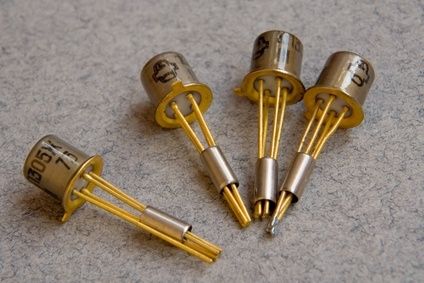
transistors 3

Little switching devices (ie transistors) like the ones on the left, millions of which are embedded in all computer chips, have now flooded the world like the great deluge in the time of Noah. They have changed more of the world more rapidly than any previous man made phenomena ever did in history. The Ark of course, was the sanctuary for humanity, fauna and most likely the flora of the earth at that time, to save them from drowning.

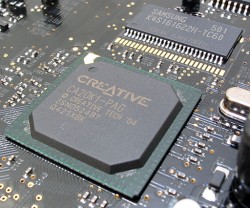
transistor 51 million

This tiny chip (left) has 51 million transistors in it!

I have long thought that we need a sanctuary from the ill effects of all this deluge of technology that is changing people’s behaviour in the most dramatic ways. So what is this sanctuary?

Despite its plusses, much technology is destructive and one of the most pernicious and invisible technologies is what enables the surveillance society, the all-seeing eye of the state which has left great tranches of the population, knowingly or unknowingly in a state of fear and without computer technology this would not exist. Everyday the NSA in the USA logs billions of email and phone communications for its own nefarious ends, thanks to these trillions of little transistors which have now populated the planet in every electronic device.

A few weeks ago Glen Greenwald, an eloquent anti-surveillance activist blogged in the London Guardian about the misdemeanours of General Pitraeus, the ex- general and CIA director in waiting (no more) and how it was a demonstration of how the surveillance society, if left to get bigger and bigger would finally eat itself. Read his blog and see the video of himself as he unravels the way it all works.  http://www.guardian.co.uk/commentisfree/2012/nov/13/petraeus-surveillance-state-fbi

My interest in this is not as an activist, as Greenwald is doing that pretty well, but in finding a religious perspective, because this is always the missing component in any public discourse like this. Fear is a well understood human emotion and one which has its uses and its pitfalls. Without it we would do the most stupid things like walk off cliffs or stick live electric cables in our mouths putting ourselves in mortal danger. But irrational fear has taken hold of populations at different times and is well known and well documented. My late father-in-law was one of the people who on hearing the radio broadcast in 1938 of Orson Wells’ The War of the Worlds, headed as fast as he could out of New York City in his car. It’s called mass hysteria and it is real.

I know quite a few people whose lives are currently and very topically ruled by fears of the apocalypse due tomorrow (at the time of writing) and there are great tranches of the public as well,  some who I know personally, who drone on about it continually. All this seems to fit into a mindset of general conspiracy theories about reptiles who rule the earth and so on. A familiar and well populated territory. It seems to dovetail into a general avoidance of a kind of responsibility for their own lives and a failure to face up to problems that the end of the world or the coming Messiah will conveniently extirpate!

But when confronted directly with this I have a standard response:

When a man asked the noble Prophet of God “when is the Hour?”, he replied, “what have you prepared for it?” Wise words. The Prophet did not speculate about when or how or why. I just wonder if this apocalypse syndrome is a deep attachment to a world which is for each of us slipping away regardless of a coming apocalypse. Each of our lives, after all, has a determined span and we all have our own personal end awaiting us, the end of a transitory and now ever transistory world.

transistory 6

One of the spin-offs of this digital transistorised universe is the all-seeing eye of CCTV which is an interesting metaphor for an all-seeing and cognisant God who has no need of cameras and sees far deeper than peoples’ outward forms. Greenwald’s observations were that even if you have nothing to hide, the mere presence of cameras changes your behaviour and impedes your freedom which I believe is true. But there is another side to this. Forget the cameras, imagine that an unimaginable power has surveillance over your innermost thoughts and impulses. For sure that’s going to change your behaviour. And maybe for the good. Many of course would dismiss this notion but the same people will believe passionately that they are monitored excessively by an all-seeing but unseen government/corporate duopoly.

Interestingly there are several well known and recommended formulae from the Blessed Quran which are generally for protection but which are to do with vision and God’s power to contain all vision. In other words what is seen by human eyes is only what God permits to be seen. As I said before, this vision is more than the physical eye can perceive – it is a perception of all that is known. This kind of response for me is the only sanctuary I know against the technological flood under which humanity is currently drowning and the fears it inevitably creates in the hearts of men.

Seasons Greetings!

Posted in language, miscellaneous, religion, Uncategorized | Leave a comment

A Worm in Your Ear

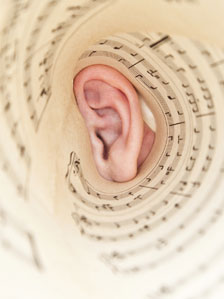
Ear worms crawl in your ear when you least expect and when you suddenly find yourself singing a melody in your head you didn’t really want to, over and over again. Apparently it is worse if you are musical. Worse if it’s a tune you have composed yourself. Mind you I’ve experienced this for many many years and developed a strategy for stopping it. This wormed its way into the news recently because a music researcher had approached the subject scientifically and was seeking a cure, but didn’t suggest anything revolutionary for dealing with it, in my eyes (or rather ears).
      There are some useful practices that come from a metaphysical understanding of certain invisible influences that the human heart is exposed to. In Thomas Cleary’s English translation of The Qur’an (Starlatch 2002) his interesting interpretation of the word for Satan is The Obsessor, which is a long way from the traditional notion of the devil and the immediate image most people might have of a fiery horned beastly bogeyman with a tail who wreaks havoc on the earth. Or just not believing he exists at all, yet another devilish ploy.  Just to fill you in, the devil, from Muslim tradition, definitely exists but is just one of several enemies to man and by no means the greatest. Without getting into the history of Satan’s refusal to bow down to man out of arrogance, it’s enough to explain that out of vengeance he vowed to lead man to destruction and to lead him away from worship of God till the end of time. But it is by deception, suggestion and whispering in the hearts of men and women (around whom he hovers) that he would accomplish this.
      In fact the first gift we have from the Qur’an is protection from any influence of the devil, and it’s all from phrases seeking refuge with God from the devil. If you maintain physical purity and a knowledge of some basic verses of protection these Satanic suggestions are simply dealt with. Other influences like the endless thought impulses (the monkey mind) that beset all people, as well as love of the world are also enemies, but the ego or the self is traditionally considered the worst and most intransigent enemy of all. My own understanding of this is (and I don’t claim to be an expert) is that the evil of creation is something distinct and which it also necessary to seek protection from. There are many ways of protecting ourselves and our families from the many hazards of existence and I plan another blog on this subject in the future as it of primary importance and usefulness and a subject which I don’t think has been grasped by many people or explained in an accesible way by our various teachers and translators.
      Back to ear worms. The above being so, any kind of obsessive thoughts like repetitive tunes can be dealt with in various ways either by repeating many times in Arabic “I seek refuge with Allah from the accursed Satan” but in Arabic: audhubillahi mina shaytan ar-rajeem.” Alternatively you can replace the tune in your head with a different tune from a purer spiritual source (eg an Andalusian or Turkish qasida melody or even, for example, a Provencal carol if you know any) –  that’s what I usually do. When I used to spend a lot of time in recording studios where it was often necessary to do many takes of a song, that same song would often haunt me at night whilst trying to sleep and was quite horrible. People say the devil has the best tunes. Er…no. I think the devil himself must have suggested that idea to someone. Maybe he makes the best earworms. The devil might well concoct the most commercial tunes, but the best tunes are most certainly angelic, celestial tunes and why they disperse immediately that hellish suffocating feeling of being trapped in some earthly melody. So powerful are these earworms that people physically close to me, like my wife, will start humming or singing the very same tune if it is inhabiting my brain. Infectious ear worms no less.
      Recently I found when I was out digging in my garden that I would always find myself singing ‘Hey Bungalow Bill who did you kill…‘ for no apparent reason, a song I really detest – or some other irritating repetitive tune , so I would be forced to take steps (described above) to rid my head of it although it would slip back if I wasn’t careful. It has become a useful kind of meter to gauge just how awake I am. It is as if the tongue is meant to be doing something at any given time and of course if you look hard enough you will find advice from many teachers and scholars who counsel you to keep the tongue repeating at all times the various Qur’anic Arabic formulae well known to the Muslims which have been handed down from a very long time ago. It is what stops the mind (and the body) from wandering and so is of enormous benefit.
     There is much on the internet on this subject eg http://www.bbc.co.uk/news/magazine-17302237
but I felt it necessary to give a religious perspective. If you have a way of dealing with earworms then email:
earwormcures@gmail.com who are constructing a database on this subject.
Posted in miscellaneous, music, religion, tassawuf | 2 Comments