

Daniel Abdal Hayy Moore, passed away yesterday April 18 after several years of cheerfully coping with illness. He was a night bird poet who invariably wrote in the early hours. Like a nightingale his song was only heard by a few but fortunately was recorded in all the many books he self-published over a fifteen year period till the time of his death. It is said that when a poem is recited the spirit of its author appears in some way and it’s in his poetry that you can still meet with him. There is a huge volume of his work but it is hoped an anthology can be assembled soon to present the essence of his work to a bigger audience. He was well known as a beat poet in the 1960s in the USA and was brought to a large audience by the City Lights bookshop in San Francisco, and his name was always linked with Alan Ginsberg and Laurence Ferlinghetti. But it was a world of poetry that I had little to do with. I only knew him as a fellow traveler through the wild and rocky roads of a Sufi brotherhood over a period of around 45 years.
Others could relate in more detail better than me his early fame in the Floating Lotus Opera Company in San Francisco during the late sixties and the internet might reveal more details and even movie footage. Remember this was in the height of the flower revolution fuelled by LSD and many other stimulants. Many of the pioneers of this new frontier were cosmic explorers seeking whatever they could of Eastern universal wisdom in all its many manifestations, Sufism included. And Islam finally.
He was an early follower of Suzuki Roshi, the famous Zen master, and he once gave me a tour of his old dojo in the heart of San Francisco where a row of small black zen cushions in a large wood panelled downstairs room was evidence of where the disciples endured hours of meditation.
Abdal Hayy was plucked out of that Zen Buddhist world and the shaymanic theatrical world of the Floating Lotus and hip poetry, by the actor Ian Dallas and it was 1971 when I first met Abdal Hayy in London, shed of his long hair, prayer beads in hand. He was en route to Morocco with some other Californians to meet the famous venerable Sufi shaykh in Meknes, Muhammad Ibn al Habib, where he was appointed a muqqadem (a deputy) by the Shaykh. When he finally fled from the gravitational pull of the various communities he found himself living in for many years, he ended up in Philadelphia where he remained till his death. Having been curiously prohibited from writing early on by Ian Dallas, in his newly won freedom, Abdal Hayy began writing poetry again, and prolifically so.
I worked on quite a few of his books and although I must admit I am no connoisseur of poetry there was always a few of his poems that caught my eye. The poems I liked best were honest, observant, surreal, self deprecating and often humorous. The book I know best is Ramadan Sonnets from 2006 which acts as a kind of vessel which could contain his genius. The opening poem The Inevitable is about fasting, and quite timely which is why I quote it here:
It’s like practicing for death. No food or drink
during daylight hours no matter
what, in the
heat of summer or
cold of winter,
and no way out of it but through
sickness, pregnancy, menstruation, madness or travel.
So that
it’s something that comes
inevitably each year, like it or not, whether or not
you’ve got a knack for it, and
some do, and love to fast, and
thrive on it, but
I do not, yet
each year it makes its visit, and year after
year it builds up to be a
sweet thing,
which make it like death, the way its
always on the
horizon, and an
absolute obligation, which must be
why Muslims often die well, They’ve had a
lifetime of Ramadans tenderizing them
for The Inevitable. And the Inevitable surely comes.
–––––––––––––––––––––––––––––––––––––––
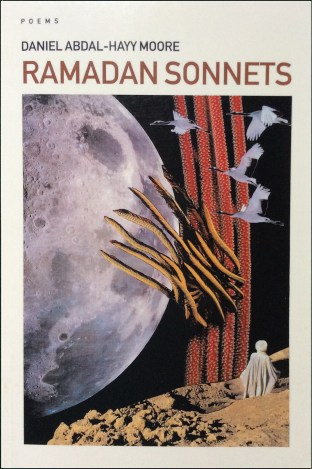 But appreciating poetry is always a very personal thing and many people just don’t get it. It tries to express what cannot be expressed in any other way. I also loved the way Abdal Hayy’s words just tripped out of his pen as if they had minds of their own in his endless efforts to define impossible spiritual heights in verse. Loose, free verse. He didn’t really have time for rhyme though it would pop up every so often. In fact I asked him several times to write in rhyme so I could set it to music. I managed to make Raspberry Juleps, one of his poems from the Ramadan Sonnets into a song as it had a bit of rhyme in it. It was unavoidably and inevitably west coast sounding like a Robert Hunter Grateful Dead track. The words always flavoured the song:
Raspberry Juleps sweet as cucumbers,
delicate froth on the rim of the glass,
even the hasty buffalo lumbers
slowly when entering Paradise Pass.
Tweets in triplets cascade in a mass
from eaves where chickadees sit by the trail,
suddenly filtering down through the grass
I imagined appearing in this vale
of tears in the modern city, chromium wail
of silent citizens taking their walks.
Silver in rays, sparkles like chain mail
flash through the nonsense everyone talks
Why not see canyons filling with light?
Any moment leads to some insight.
——————————————-
Even though he tried to express the divine in his poetry, he was still in some ways very much to me the west coast beat poet appraising in his nightly vigils wondrous and infinite celestial and very spiritual inner worlds as well as just the plain ordinary. His words were his rocket fuel, launching him constantly into wonderful journeys into the inner beyond. His own artwork adorned most of his book covers and was a glimpse of the surreal worlds he looked out on and which had surrounded him in his early life in the floating Lotus. He was ever conscious that his imagery would never be endearing to Muslim bookshops. But he stuck to his guns and carried on regardless creating ever stranger collages and odd juxtapositions.
His poetry was always God conscious poetry and it came from from an encyclopaedic knowledge of the subject. He really knew poetry inside out, and poets too whether from the Caucasian or Hispanic universes. Where he is now only God knows, but I’m sure he is writing a poem about it.
Email me at cwdm.typography@gmail.com
Design work: cwdm-portfolio.com







 Ian Whiteman
Pass the Parcel
The graveyard of 6 million at Najaf, south of Baghdad.
Professional journalists usually have to fill column inches to order,
which accounts for their flights of fancy or in many cases outright
lies. Bloggers, unless they are driven lunatics, tend to post stuff as
and when they feel inspired. Which is why reading blogs is often more
informative than most news sources, printed or electronic.
In the summer months I tend to put my feet up and take a blog holiday
as to tell the truth I think I stop thinking in the heat or I’m
otherwise occupied watering plants or just trying to stay cool. But I
can see the need soon for a special obituary page on my blog as
increasing numbers of my friends are entering the ante chamber of life
or should that be death. There has been a rush to old age for some
time with my generation and naturally it’s regularly a topic
of conversation. Where are you going to be buried? And so on…..and
why not? Nothing morbid about it. Just forward planning.
I’ve blogged two obituaries in the last six years of people close to
me which is not exactly a lot. But my late brother Kaye, himself a
journalist, wrote quite a few obituaries over the years for the
Guardian and other newspapers – mostly obituaries of other
journalists, writers or political figures who were connected to
Africa, his area of interest. Until of course he passed away himself
two years ago and some other journalist had to write his obit for the
Guardian. Like a macabre game of pass the parcel except the idea is to
keep the parcel as long as you can.
In fact when Kaye died I was in California so I missed his actual
funeral but was able to go to a memorial for him in Chatham House in
London a few months later. I say event because if you put a lot of
journalists and their coterie of politicians, diplomats and
businessmen together, especially if half are Africans or
Afro-Caribbean, it’s more of a party than a serious memorial for the
one who has passed on.
Mind you it was quite serious in places and at one point a giant
Nigerian who arrived halfway through the proceedings burst into tears
as he mentioned Kaye’s name. But the recollections were generally humorous with a well known Jamaican writer recalling the time when he met up with Kaye, newly
married back in 1963. Asked where she was, Kaye said that Marva, his
new wife, was tied up at home and was unable to come. Our Jamaican
writer pointed out wryly that where he comes from people had a kind of
literal understanding of the language and that tied up meant … tied
up! Much mirth.
In the room full of over 100 people I felt a warmth and mutual respect
amongst them but not in a politically correct fashionable multiracial
kind of way but quite real. I was moved. When I was introduced as
Kaye’s youngest brother to the large Nigerian journalist who had wept
on the podium, he clasped me in a giant bear hug. But of course
waiting upstairs were the drinks and once the dedications were over
there was a stampede. I’m afraid alcohol is the lubricant of most
journalists’ lives, my brother included.
I recall visiting him once in his office, the HQ, of West Africa ,
somewhere in south London. West Africa was a political weekly he
edited for 20 years, mostly about Nigeria and its three storey
headquarters was inhabited entirely by Nigerians. But at the very top
in the Managing Editor’s office was the very white Mr Whiteman. A
symbolic and defining image of my brother’s life.
My own generation is ten years behind that of my brother so there is
less shuffling going on to get off this mortal coil but the shuffling
has definitely started and passing the obituary parcel has begun. I’ve
written two obits in total in 6 years which seems to indicate that
most of my friends are still alive and kicking. Who will do the next
obituary? Who will do mine? Do we actually need obituaries?
We bury these realities as we bury the dead or incinerate them as is
the fashion even here in Spain these days. It’s the not talked about
taboo subject in modern cultures or else it’s the headline item that
is guaranteed to sell newspapers or pull in tv advertising. More
deaths = more advertising. As the Australian arch lizard of the news
business correctly observed: news is entertainment, and horror and
death sells and always has. The tv channels are filled with whodunnits
always featuring the gruesome ritual pulling back of the green shroud
in the mortuary for us to see how well an actor can act being dead.
This culture is probably the only civilization in history with zero
knowledge of what happens next. It’s all about somehow extending life
at all costs by miraculous medical techniques putting huge profits
into the transplant industry and leaving simple cheap life preserving
measures un-financed. Also the arms manufacturers guarantee that for
some, extending life is not their plan but the serious curtailing of
it – for a lot of people.
As Abe Lincoln said “it’s not the years in your life that matters but
the life in your years.” Quality not quantity. Isn’t that a better
attitude? Or as Al Ghazali said 700 years ago “only the deceived fool
rejoices as his wealth increases as each day his life shortens.”
Best to look death in the face and smile … it will descend.